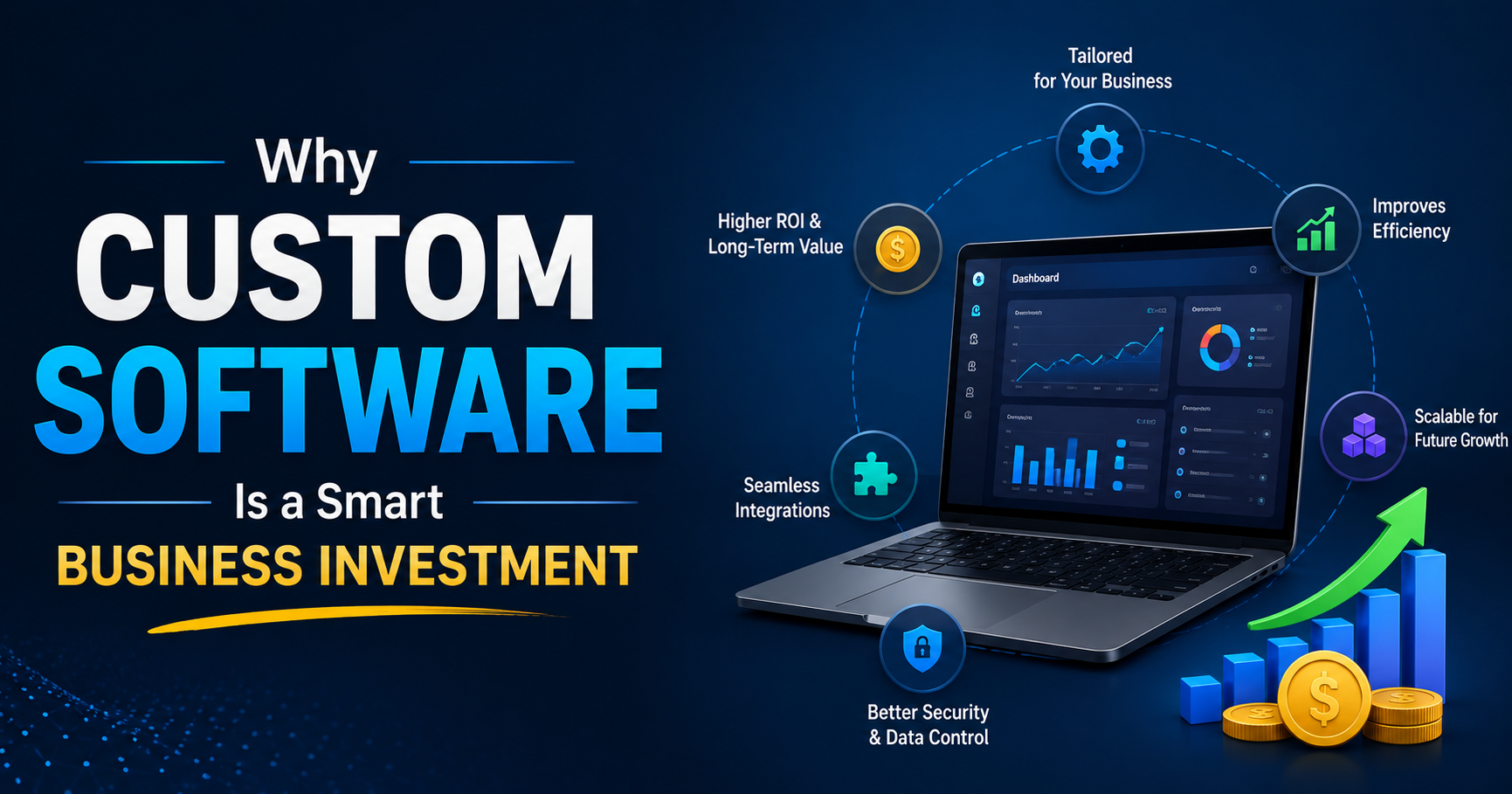
Why Custom Software Is a Smart Business Investment
Businesses are increasingly relying on technology to manage operations, serve customers, analyze data, and stay competitive. While ready-made software can solve common problems, it may not always fit the unique workflows and goals of a growing business.
This is where custom software development becomes valuable. Instead of adapting business processes to an existing platform, custom software is designed around the organization's specific requirements. Although the initial investment can be higher, the long-term benefits can make it a smart business decision.
What Is Custom Software?
Custom software is an application or digital system developed specifically for a particular business, industry, or set of requirements.
Unlike generic software, custom solutions can be built around existing workflows and customized as the organization grows. They can include business management platforms, CRM systems, ERP solutions, inventory applications, customer portals, booking systems, e-commerce platforms, and industry-specific applications.
The primary objective is to solve specific business challenges rather than provide a one-size-fits-all solution.
1. Designed Around Your Business
One of the biggest advantages of custom software is flexibility.
Off-the-shelf applications often provide predefined features that may not match your workflow. Businesses may end up changing their processes to accommodate the software or paying for features they never use.
Custom software takes the opposite approach. Developers analyze your business processes and create functionality around your actual requirements.
This can make daily operations more efficient and reduce unnecessary steps.
2. Improves Operational Efficiency
Manual processes can consume valuable time and increase the possibility of errors.
Custom software can automate repetitive tasks such as:
- Data entry
- Invoice generation
- Inventory updates
- Customer management
- Employee workflows
- Reporting
- Notifications
- Document processing
Automation allows employees to focus on higher-value activities while reducing repetitive administrative work.
3. Integrates With Existing Systems
Businesses often use multiple platforms for different departments. When these systems cannot communicate effectively, employees may have to transfer information manually.
Custom software can be developed with APIs and integrations that connect different business systems.
For example, a custom platform could connect your:
CRM + ERP + Accounting Software + Inventory + Website + Mobile App
This creates a more connected technology ecosystem and helps reduce duplicate data entry.
4. Better Scalability
Business requirements change as companies grow. A system that works for a small organization may become restrictive when the business expands.
Custom software can be designed with future growth in mind. New modules, users, integrations, reports, and features can be added as requirements evolve.
Scalable architecture can help businesses avoid replacing an entire system simply because their existing software has reached its limitations.
5. Stronger Data Control and Security
Data security is an important consideration for modern organizations. Businesses may handle customer information, financial records, employee data, and confidential business information.
With custom software, organizations have greater control over how their systems are designed and how information is accessed.
Developers can implement features such as:
- Role-based access
- Secure authentication
- Data encryption
- Activity monitoring
- Permission management
- Automated backups
- Secure API communication
Security requirements can also be adapted to the specific risks and compliance needs of the business.
6. Better Customer Experience
Technology isn't only about internal operations. Custom software can also improve how customers interact with a business.
Businesses can create customized:
- Customer portals
- Mobile applications
- Booking systems
- E-commerce platforms
- Self-service dashboards
- Support systems
A smoother digital experience can make it easier for customers to find information, place orders, manage accounts, or communicate with the business.
7. Reduces Long-Term Software Limitations
A low-cost software subscription may initially appear more affordable, but expenses can increase as businesses add users, features, integrations, or premium plans.
Custom software can provide greater control over functionality and development priorities.
Instead of continuously working around limitations, businesses can invest in features that directly contribute to their operations and growth.
The total cost should therefore be evaluated over the software's expected lifespan rather than only by comparing initial development prices.
8. Provides Valuable Business Insights
Modern custom applications can include dashboards, reports, and analytics tools that help management make informed decisions.
Businesses can monitor information such as:
- Sales performance
- Customer activity
- Inventory levels
- Employee productivity
- Revenue trends
- Operational costs
Having relevant information available in one system can make it easier to identify trends and respond to business opportunities.
When Should a Business Consider Custom Software?
Custom software may be worth considering when:
- Existing software doesn't match your workflows
- Employees rely heavily on manual processes
- Multiple systems need to be connected
- Your business requires specialized functionality
- Data is spread across different platforms
- Existing software isn't scalable
- You need greater control over security and data
- You want to create a unique digital product
However, custom development isn't automatically the right choice for every business. Companies should first evaluate their requirements, budget, expected return, and long-term goals.
How to Make Custom Software a Smart Investment
The success of a custom software project depends heavily on planning.
Start by identifying the business problem rather than simply listing desired features. Define measurable objectives, prioritize essential functionality, select suitable technologies, and create a realistic development roadmap.
It is also important to work with an experienced development team that can provide UI/UX design, development, testing, deployment, integrations, and ongoing maintenance.
Starting with an MVP can also help businesses validate the concept before expanding into advanced features.
Conclusion
Custom software can be a strategic investment for businesses that need technology built around their specific operations and future goals. From automation and integrations to scalability, security, customer experience, and analytics, a well-designed solution can provide benefits that generic software may not deliver.
The goal shouldn't simply be to build software. It should be to solve business problems, improve efficiency, reduce operational friction, and create a technology foundation for sustainable growth.
When carefully planned and developed, custom software can become more than an application—it can become a long-term business asset.