API Integration Services: Connect Business Systems & Automate Workflows
Modern businesses rely on multiple digital platforms to manage customers, sales, payments, inventory, accounting, marketing, and daily operations. When these systems work independently, employees often have to move information manually from one application to another.
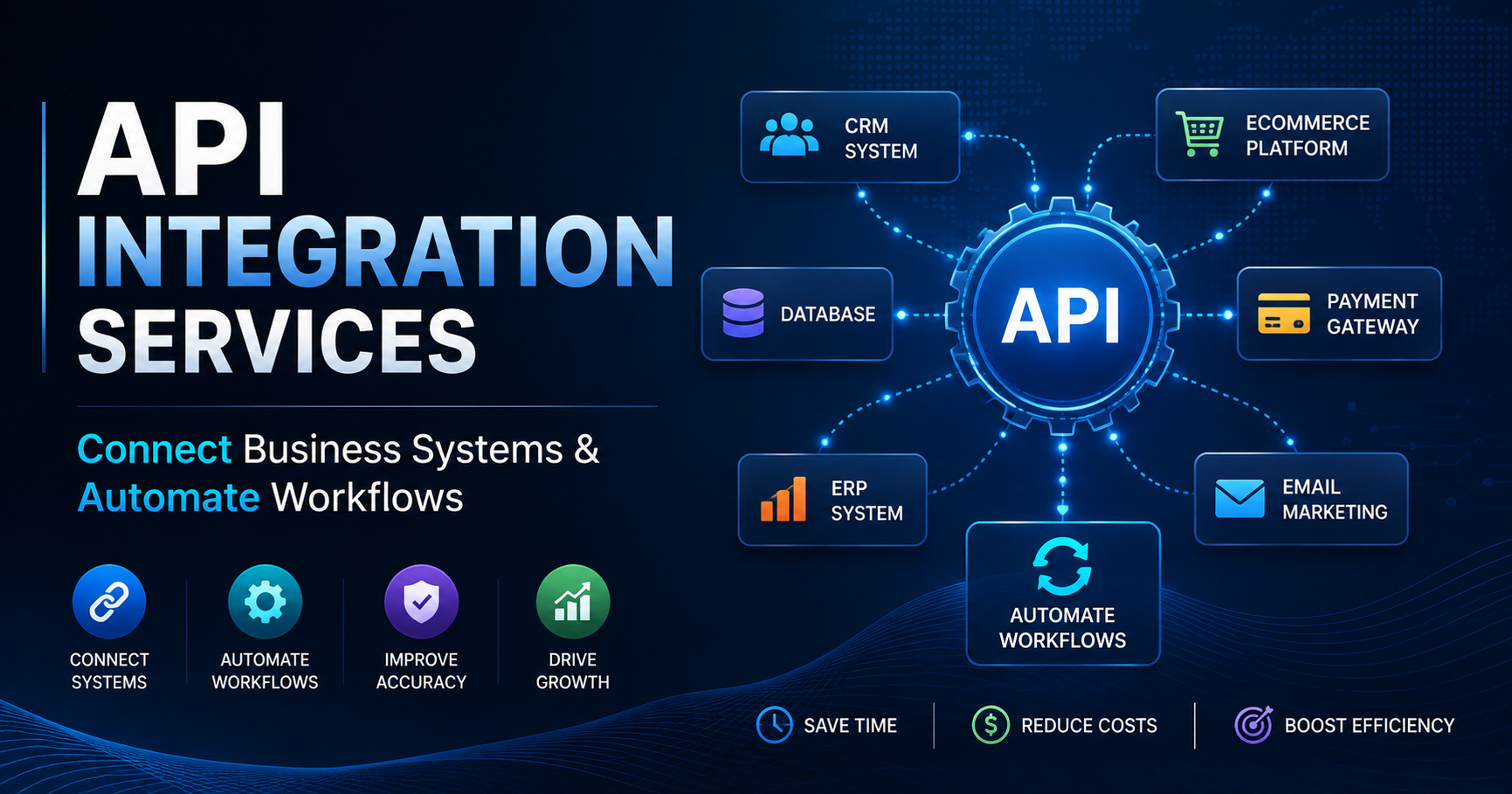
API integration services solve this problem by connecting different software systems and allowing them to exchange data automatically. From CRM and ERP integration to payment gateways and mobile applications, APIs help businesses create connected and efficient digital workflows.
What Is API Integration?
API stands for Application Programming Interface. It provides a structured way for different software applications to communicate with each other.
API integration connects two or more applications so they can exchange information or trigger actions automatically.
For example, when a customer places an order through an e-commerce website, an API integration can automatically:
Receive the order → Update inventory → Process payment → Create an invoice → Update the CRM → Send confirmation
This eliminates many manual steps and helps businesses process information faster.
Why Do Businesses Need API Integration?
As businesses grow, they typically adopt more software tools. A company may use one platform for customer management, another for accounting, another for inventory, and another for online sales.
If these systems aren't connected, businesses may experience:
- Duplicate data entry
- Manual processes
- Data inconsistencies
- Delayed information
- Increased operational costs
- Higher risk of human errors
API integration creates a connection between these platforms, allowing information to move automatically between systems.
Benefits of API Integration Services
1. Automate Repetitive Tasks
Automation is one of the biggest advantages of API integration. Instead of employees repeatedly entering the same information into different applications, connected systems can perform these tasks automatically.
For example, when a visitor submits a form on a website, their information can automatically be added to the company's CRM.
2. Improve Data Accuracy
Manual data entry can lead to spelling mistakes, duplicate records, and outdated information. API integration reduces the need to enter the same data multiple times.
When systems share information automatically, businesses can maintain more consistent and reliable data.
3. Increase Operational Efficiency
Connected applications reduce unnecessary steps in business workflows.
For example, an online order can automatically move from an e-commerce platform to inventory management and then to accounting software. Employees don't need to manually transfer the same order information between systems.
4. Improve Customer Experience
API integration can also improve customer-facing services.
Businesses can connect websites and applications with:
- Payment gateways
- Shipping platforms
- CRM systems
- Booking systems
- Communication tools
- Customer portals
- Mobile applications
This can help customers receive faster updates and more seamless services.
5. Support Business Growth
A growing business may need to handle more customers, transactions, employees, and data. Connected systems can help businesses manage this increasing workload more efficiently.
A well-designed API architecture can also make it easier to introduce new platforms and services in the future.
Common API Integrations
API integration can be used across different business functions.
CRM Integration
Websites, lead-generation forms, email platforms, and mobile apps can be connected with a CRM to automatically capture and update customer information.
ERP Integration
Businesses can connect websites, sales systems, inventory platforms, and other applications with ERP systems to synchronize operational information.
Payment Integration
Payment APIs allow websites and applications to communicate with payment providers, process transactions, and receive payment status updates.
E-Commerce Integration
Online stores can connect with inventory, shipping, accounting, CRM, and payment systems to automate order-related workflows.
Mobile App Integration
Mobile applications can communicate with backend systems, databases, cloud platforms, payment services, and third-party applications through APIs.
How API Integration Works
A successful integration usually follows several steps.
1. Requirement Analysis: Identify the systems that need to communicate and determine what information should be exchanged.
2. API Analysis: Review API documentation, endpoints, authentication methods, data formats, and limitations.
3. Integration Planning: Define the data flow and determine which actions should happen automatically.
4. Development: Developers build the required API connections and data-processing logic.
5. Testing: Test data accuracy, security, error handling, performance, and different workflow scenarios.
6. Deployment and Monitoring: Deploy the integration and continuously monitor its performance and reliability.
API Security and Reliability
Security is essential when connecting business systems. APIs can provide access to valuable business and customer information, so integrations should be designed with appropriate security controls.
Important practices include:
- Secure authentication
- Authorization and access controls
- Encrypted communication
- Input validation
- Secure data handling
- Error monitoring
- Activity logging
Reliable integrations should also include proper error handling. If one system temporarily becomes unavailable, the integration should be able to handle the failure without unnecessarily losing or duplicating information.
Custom API Integration vs Ready-Made Connectors
Some platforms provide ready-made connectors that work well for simple requirements. However, businesses with specialized workflows may require custom API integration.
Custom integration can be useful when:
- Existing connectors don't support your systems
- Multiple platforms need to communicate
- Complex data transformation is required
- Business workflows are unique
- Advanced security requirements exist
- Standard connectors lack important functionality
The best approach depends on the business's technology environment and integration goals.
Choosing an API Integration Services Provider
Before hiring an integration partner, businesses should evaluate:
- API development experience
- Previous integration projects
- Security practices
- Technology expertise
- Testing methodology
- Documentation
- Monitoring capabilities
- Maintenance and support
A professional provider should understand both the technical requirements and the business workflow behind the integration.
Conclusion
API integration services allow businesses to connect disconnected applications, automate repetitive workflows, and create a more efficient digital environment. From CRM and ERP systems to payment gateways, e-commerce platforms, accounting software, and mobile applications, APIs can connect the technologies businesses depend on every day.
The value of API integration goes beyond simply transferring data. A well-designed integration can reduce manual work, improve data accuracy, streamline operations, enhance customer experiences, and support long-term business growth.
As organizations continue adopting new digital tools, building reliable connections between those systems can become an important part of a scalable technology strategy.