Digital Marketing Trends in 2026: Every Business Should Know
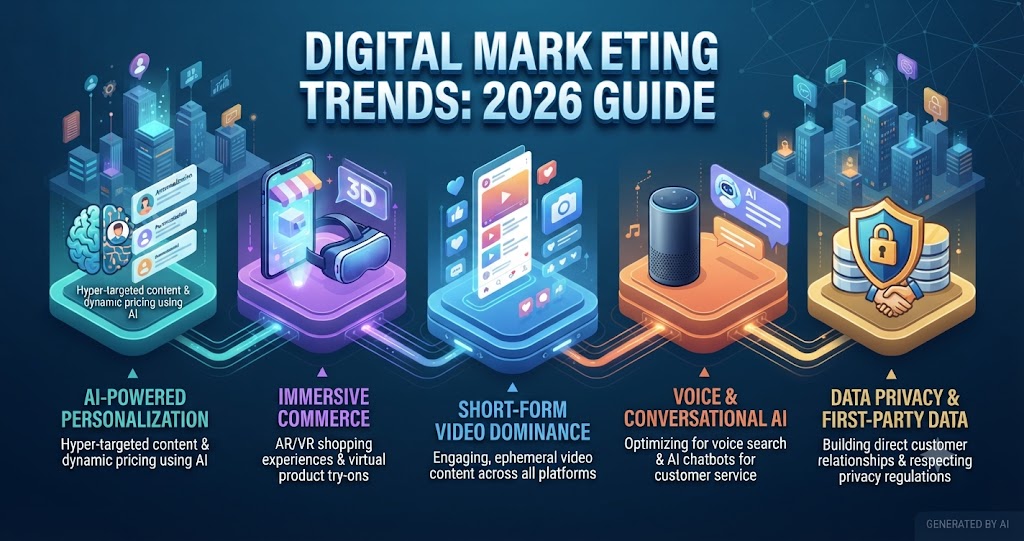
Digital marketing is changing rapidly as artificial intelligence, conversational search, short-form videos, and personalized experiences reshape how customers discover businesses. Strategies that worked a few years ago may no longer generate the same results.
In 2026, businesses must focus on building trust, delivering useful content, and reaching customers through the channels they use most. Here are the leading digital marketing trends and strategies every business should understand.
1. AI-Powered Marketing Becomes Essential
Artificial intelligence is no longer limited to large companies. Businesses of every size can now use AI tools to automate repetitive work, analyse customer behaviour, generate content ideas, and improve advertising campaigns.
AI can support marketers with:
- Customer segmentation
- Marketing automation
- Email personalization
- Content research
- Chatbot conversations
- Sales forecasting
- Advertising optimization
However, businesses should not publish large amounts of unedited AI-generated content. Google recommends using AI to support original, accurate, and valuable content rather than creating pages mainly to manipulate rankings. Google’s AI content guidance confirms that quality and usefulness remain important.
The best strategy is to combine AI efficiency with human creativity, expertise, and review.
2. Search Is Becoming More Conversational
People are increasingly searching with complete questions instead of short keywords. They may use Google’s AI features, voice assistants, chatbots, or other AI-powered platforms to find information.
For example, a user may search:
“What is the best custom software solution for a small business?”
This change makes Answer Engine Optimization, or AEO, increasingly valuable. Businesses should create content that answers specific customer questions clearly and directly.
To improve visibility in conversational search:
- Use natural, question-based headings
- Provide concise answers near the beginning
- Include relevant examples
- Create helpful FAQ sections
- Demonstrate genuine experience and expertise
- Add accurate structured data where appropriate
Traditional SEO is still important. Google states that established SEO best practices continue to apply to AI Overviews and AI Mode. Google’s generative AI search guide particularly emphasizes unique, useful content and strong technical foundations.
3. Short-Form Video Continues to Grow
Short-form videos remain one of the most engaging content formats in 2026. Instagram Reels, YouTube Shorts, and similar formats help businesses explain products, share quick tips, and build stronger relationships with their audiences.
A business does not always need expensive production. Authentic videos recorded on a smartphone can perform well when they offer useful information.
Effective video ideas include:
- Product demonstrations
- Customer success stories
- Behind-the-scenes content
- Quick educational tips
- Frequently asked questions
- Before-and-after results
Businesses should add captions because many users watch videos without sound. The opening seconds should also communicate a clear reason to continue watching.
4. Personalization Moves Beyond Using a Customer’s Name
Modern personalization involves delivering content based on a customer’s interests, actions, location, purchase history, or stage in the buying journey.
An eCommerce business, for example, can recommend products related to previous purchases. A software company can send different information to a startup and an established enterprise.
Useful personalization strategies include:
- Behaviour-based email campaigns
- Relevant product recommendations
- Retargeting advertisements
- Location-specific landing pages
- Customized website content
- Audience-specific offers
Businesses must use customer data responsibly and provide transparent privacy and consent options.
5. Social Commerce and Messaging Become More Important
Social platforms are becoming complete customer journeys where users can discover a brand, ask questions, evaluate an offer, and make a purchase.
Messaging is especially valuable because customers often want an immediate response before making a decision. WhatsApp, Instagram Direct, and website chat can help businesses answer questions and collect qualified leads.
Meta has continued expanding centralized campaigns and AI-assisted business support for WhatsApp, showing how marketing and customer conversations are becoming more closely connected. Meta’s WhatsApp business update supports this direction.
Businesses should make it easy for customers to move from an advertisement or social post directly into a conversation.
6. First-Party Data Becomes More Valuable
Businesses need reliable information collected directly from their customers. This is known as first-party data and can include website enquiries, purchase history, newsletter subscriptions, surveys, and CRM records.
Companies can strengthen their first-party data strategy by:
- Offering useful downloadable resources
- Creating email newsletters
- Collecting customer feedback
- Using lead-generation forms
- Maintaining an organized CRM
- Creating loyalty programmes
The goal should be to collect only necessary information and explain how it will be used.
7. Authentic Content Builds Greater Trust
Customers are becoming more selective about the brands they follow. Generic promotional content is less effective than information that demonstrates real knowledge and experience.
Businesses can build trust by publishing:
- Original research and insights
- Detailed case studies
- Honest product comparisons
- Customer testimonials
- Expert-led articles
- Transparent process explanations
Content should answer genuine customer problems instead of repeatedly promoting a product or service. Google also recommends creating reliable, people-first content rather than material designed mainly to influence search rankings. Google’s people-first content guidance reflects this principle.
8. Omnichannel Marketing Creates a Consistent Experience
Customers may discover a business through social media, visit its website, read reviews, receive an email, and finally contact the company through WhatsApp. Every channel should provide consistent information and branding.
Businesses should connect their website, CRM, email marketing, social media, advertising, and customer support systems. This makes it easier to track leads, personalize communication, and avoid losing potential customers between platforms.
Measuring Results That Matter
Likes and impressions can show visibility, but they do not always represent business growth. Companies should connect marketing performance with meaningful outcomes such as:
- Qualified leads
- Conversion rate
- Customer acquisition cost
- Sales revenue
- Return on advertising spend
- Customer retention
- Lifetime customer value
Clear performance data helps businesses invest in strategies that produce measurable results.
Final Thoughts
Digital marketing in 2026 is driven by AI, conversational search, video, personalization, messaging, and connected customer experiences. However, technology alone cannot create a successful strategy.
Businesses that provide useful information, communicate authentically, protect customer data, and measure genuine outcomes will have the strongest foundation for growth. The most effective approach is to test new methods carefully while continuing to prioritize customer needs and long-term trust.