Website Speed and SEO: Improve Rankings and User Experience
Website speed is a critical part of a successful online presence. Visitors expect pages to load quickly, work smoothly, and display correctly on every device. If a website takes too long to load, potential customers may leave before reading about its products or services.
A fast website improves user experience, supports search engine optimization, and can increase enquiries and sales. Businesses must therefore treat website performance as an essential part of their digital strategy.
Why Website Speed Matters
Website speed refers to how quickly a webpage loads and becomes usable. A good website should display important content quickly, respond immediately to user interactions, and remain visually stable during loading.
Poor website performance can affect:
- Search visibility
- Customer trust
- Mobile usability
- User engagement
- Lead generation
- Online conversions
Visitors may consider a slow or unstable website unprofessional. A faster experience encourages them to explore more pages and interact with the business.
How Website Speed Affects SEO
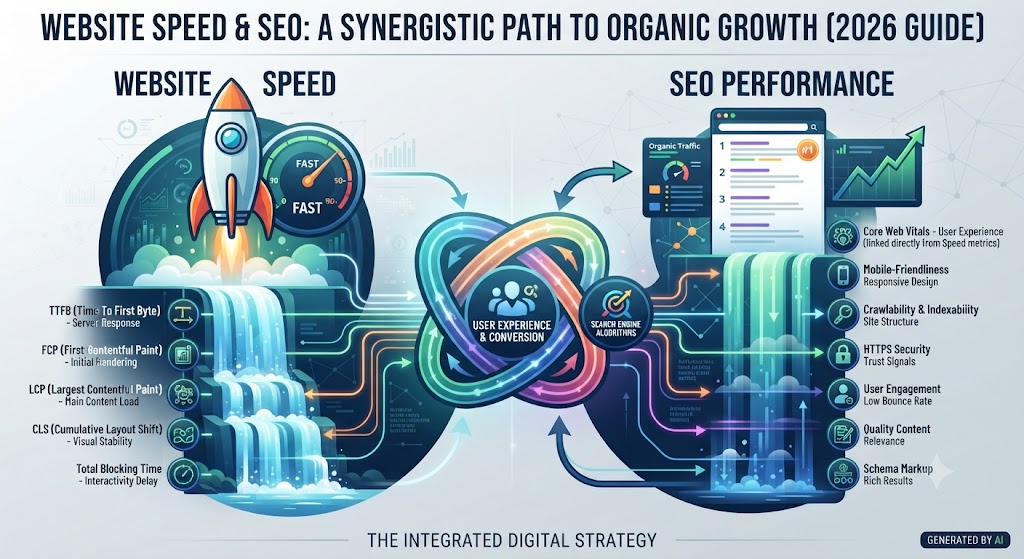
Google considers page experience when evaluating websites. Core Web Vitals are used by Google’s ranking systems, although good performance scores alone do not guarantee top rankings. Content quality, relevance, backlinks, mobile usability, and technical SEO are also important.
According to Google’s page-experience guidance, website owners should create a strong overall experience instead of focusing on only one performance score.
Website speed supports SEO in several ways:
Better User Engagement
Visitors are more likely to explore additional pages when a website loads quickly. This allows businesses to present their services, answer questions, and encourage users to take action.
Improved Mobile Experience
Many users browse websites through mobile devices and slower internet connections. A fast, responsive website makes content easier to access across different devices and network conditions.
More Conversion Opportunities
A quick and simple purchasing, booking, or enquiry process reduces frustration. Customers can complete their desired action without waiting for slow pages or forms.
Understanding Core Web Vitals
Core Web Vitals are performance metrics that measure loading speed, responsiveness, and visual stability.
Largest Contentful Paint
Largest Contentful Paint, or LCP, measures how quickly the main visible content loads. Google recommends an LCP of 2.5 seconds or less.
Large images, poor hosting, and slow server responses can negatively affect LCP.
Interaction to Next Paint
Interaction to Next Paint, or INP, measures how quickly a page responds when someone clicks, taps, or types. Google recommends an INP of 200 milliseconds or less.
Heavy JavaScript and unnecessary third-party scripts can delay page interactions.
Cumulative Layout Shift
Cumulative Layout Shift, or CLS, measures unexpected movement during loading. A good CLS score is 0.1 or less.
Images without fixed dimensions, changing fonts, and dynamically inserted content may cause layouts to shift. These recommended targets are explained in Google’s Core Web Vitals documentation.
Common Causes of Slow Websites
Website performance can be affected by design choices, code, hosting, plugins, and external services.
Common causes include:
- Large or uncompressed images
- Poor-quality hosting
- Excessive CSS and JavaScript
- Too many plugins
- Unoptimized databases
- Autoplay videos
- Multiple tracking scripts
- Missing browser caching
- Unnecessary animations
- Outdated website software
A professional speed audit can identify the exact problems affecting a website.
How to Improve Website Speed
Optimize Images
Resize and compress images before uploading them. Modern formats such as WebP and AVIF can reduce file sizes while maintaining good visual quality. Lazy loading can be used for images that are not immediately visible.
Select Reliable Hosting
A slow server delays every page request. Choose hosting based on expected traffic, website technology, security needs, and customer location. A content delivery network can also provide files from servers closer to visitors.
Reduce CSS and JavaScript
Remove unused code and minimize large files. Non-essential scripts can be delayed so that important content appears first.
Enable Caching and Compression
Browser caching allows returning visitors to reuse previously downloaded resources. Server compression reduces the size of files sent to a visitor’s browser.
Limit Plugins and External Scripts
Plugins, chatbots, tracking tools, and social widgets can increase loading time. Keep only essential integrations and remove outdated or unnecessary plugins.
Optimize Mobile Performance
Use responsive layouts, properly sized images, simple navigation, and mobile-friendly forms. Avoid intrusive pop-ups and confirm that buttons respond quickly on smaller screens.
How to Test Website Speed
Businesses can use Google PageSpeed Insights to analyse mobile and desktop performance. It provides laboratory test results and available real-user data.
Google Search Console’s Core Web Vitals report can also help identify groups of pages with performance problems.
Test all important pages, including:
- Homepage
- Service pages
- Product pages
- Blog articles
- Contact page
- Checkout or enquiry pages
Performance should be checked after design changes, plugin updates, or the installation of new marketing tools.
Why Choose Coding Rig?
Coding Rig helps businesses build and optimize fast, responsive, and SEO-friendly websites. The team examines website code, images, hosting, mobile usability, database performance, and Core Web Vitals to identify meaningful improvements.
Coding Rig provides:
- Website speed audits
- Core Web Vitals optimization
- Technical SEO services
- Mobile performance improvement
- Image and code optimization
- Custom website development
- Website maintenance and support
The goal is not only to improve a performance score but also to create a faster experience that supports customer engagement, search visibility, and conversions.
Final Thoughts
Website speed is an important part of SEO, user experience, and business growth. Fast-loading pages make it easier for visitors to find information, explore services, and complete important actions.
By improving images, code, hosting, caching, and mobile performance, businesses can create a better experience for users and search engines. Regular testing and professional optimization can help maintain strong website performance over time.