Predictive Analytics Using AI for Smarter Business Decisions
Businesses generate valuable data through sales, websites, customer interactions, inventory systems, marketing campaigns, and daily operations. However, collecting data is not enough. Companies must understand what that information means and how it can support future decisions.
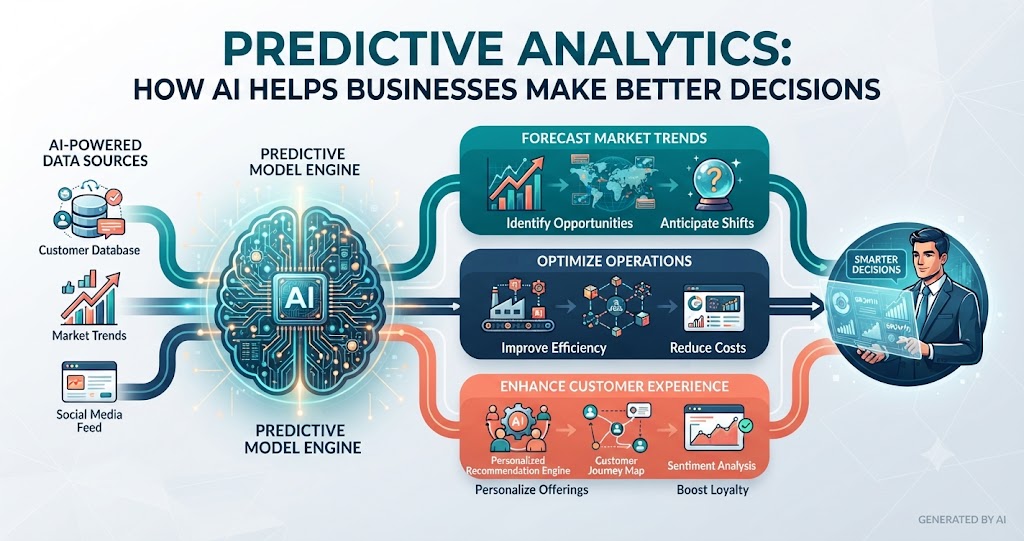
Predictive analytics combines historical data, statistical techniques, artificial intelligence, and machine learning to estimate future outcomes. It helps businesses move beyond understanding what has already happened and begin preparing for what may happen next.
What Is Predictive Analytics?
Predictive analytics is the process of studying current and historical data to identify patterns and forecast possible future results. According to IBM’s predictive analytics guide, it combines historical data with statistical modelling, data mining, and machine learning.
For example, a business may use predictive analytics to estimate:
- Future product demand
- Monthly sales
- Customer purchasing behaviour
- Employee turnover
- Equipment failure
- Marketing campaign performance
- Financial and operational risks
Predictions are not guaranteed outcomes. They provide evidence-based estimates that help decision-makers prepare more effectively.
How Does Predictive Analytics Work?
Predictive analytics generally follows a structured process.
Define the Business Problem
The company must first identify the question it wants to answer. It may want to predict which customers could leave, how much stock will be required, or which leads are most likely to convert.
Collect Relevant Data
Data can come from CRM software, ERP systems, websites, accounting platforms, customer-support records, sensors, marketing tools, and external sources.
Prepare the Data
Incomplete, duplicated, or incorrect information can reduce the reliability of predictions. Data must be cleaned, organized, and transformed into a usable format.
Build and Train the Model
Data specialists select suitable statistical or machine-learning methods. The model studies historical patterns and learns which factors are connected to a particular result.
Test the Results
The model must be evaluated using data it has not previously processed. This helps determine whether its predictions are accurate enough for the intended business purpose.
Monitor and Improve
Customer behaviour, market conditions, and business processes change. Predictive models should be monitored and updated to maintain their usefulness.
How AI Improves Predictive Analytics
Traditional analysis may require people to examine reports manually. AI and machine learning can process larger datasets, identify complex relationships, and update predictions as new information becomes available.
Google Cloud describes predictive analytics as using historical and current data to forecast future behaviour or outcomes. Modern systems can also integrate predictive insights with real-time data processing. Google Cloud’s predictive analytics overview explains this approach.
AI can help businesses:
- Process large volumes of data
- Discover patterns that may be difficult to identify manually
- Automate recurring forecasts
- Detect unusual activity
- Update predictions using new data
- Deliver insights through visual dashboards
Human judgment remains essential. Managers must understand the business context and decide how predictions should influence their actions.
Benefits of Predictive Analytics for Businesses
Better Decision-Making
Predictive analytics provides evidence that supports planning. Decision-makers can compare possible outcomes instead of depending entirely on assumptions.
Improved Sales Forecasting
Businesses can analyse past sales, seasonal demand, customer behaviour, and market conditions to estimate future revenue. These forecasts can support budgeting, staffing, and purchasing.
Personalized Customer Experiences
Predictive models can identify products or services a customer may prefer. Businesses can use these insights to create more relevant recommendations, messages, and offers.
Reduced Customer Churn
AI can detect behavioural patterns associated with customers who may stop using a product or service. Teams can then contact these customers with timely support or retention offers.
Stronger Inventory Planning
Retailers and manufacturers can estimate future demand and maintain suitable stock levels. This reduces the risk of overstocking popular items or running out of important products.
Improved Risk Management
Predictive analytics can identify unusual transactions, late-payment risks, operational problems, and potential equipment failures. Early warnings allow businesses to act before a problem becomes more expensive.
Predictive Analytics Use Cases
Predictive analytics can support many industries:
- Retail: Product demand and inventory forecasting
- Finance: Fraud detection and credit-risk analysis
- Healthcare: Resource planning and patient-risk assessment
- Manufacturing: Predictive equipment maintenance
- Marketing: Lead scoring and campaign forecasting
- Real estate: Pricing and demand analysis
- Logistics: Delivery planning and route optimization
- Human resources: Employee turnover prediction
A business should begin with one measurable problem instead of attempting to apply AI across every department at once.
Challenges Businesses Should Consider
Predictive analytics depends heavily on data quality. Incomplete, outdated, or biased information can produce misleading results.
Businesses should consider:
- Data accuracy and availability
- Customer privacy
- System security
- Model bias
- Integration requirements
- Prediction explainability
- Regular performance monitoring
Predictions should support decisions rather than make every decision automatically. Human review is especially important when results affect employment, finance, healthcare, or customer eligibility.
Why Choose Coding Rig?
Coding Rig helps businesses transform operational data into practical, AI-powered insights. Its team can develop custom predictive analytics solutions that connect with existing software and present forecasts through clear dashboards.
Coding Rig provides:
- Custom AI software development
- Predictive analytics dashboards
- Business intelligence solutions
- CRM and ERP integrations
- Sales and demand forecasting
- Customer behaviour analysis
- Cloud-based analytics systems
- Software maintenance and support
Each solution can be designed around the company’s data, workflow, industry, and decision-making requirements.
Final Thoughts
Predictive analytics helps businesses use existing data to prepare for future opportunities and risks. It can improve forecasting, customer understanding, inventory planning, marketing, and operational efficiency.
Successful implementation requires accurate data, suitable AI models, secure systems, regular monitoring, and responsible human oversight. With a clearly defined objective and the right technical support, predictive analytics can become a powerful tool for smarter business decisions.