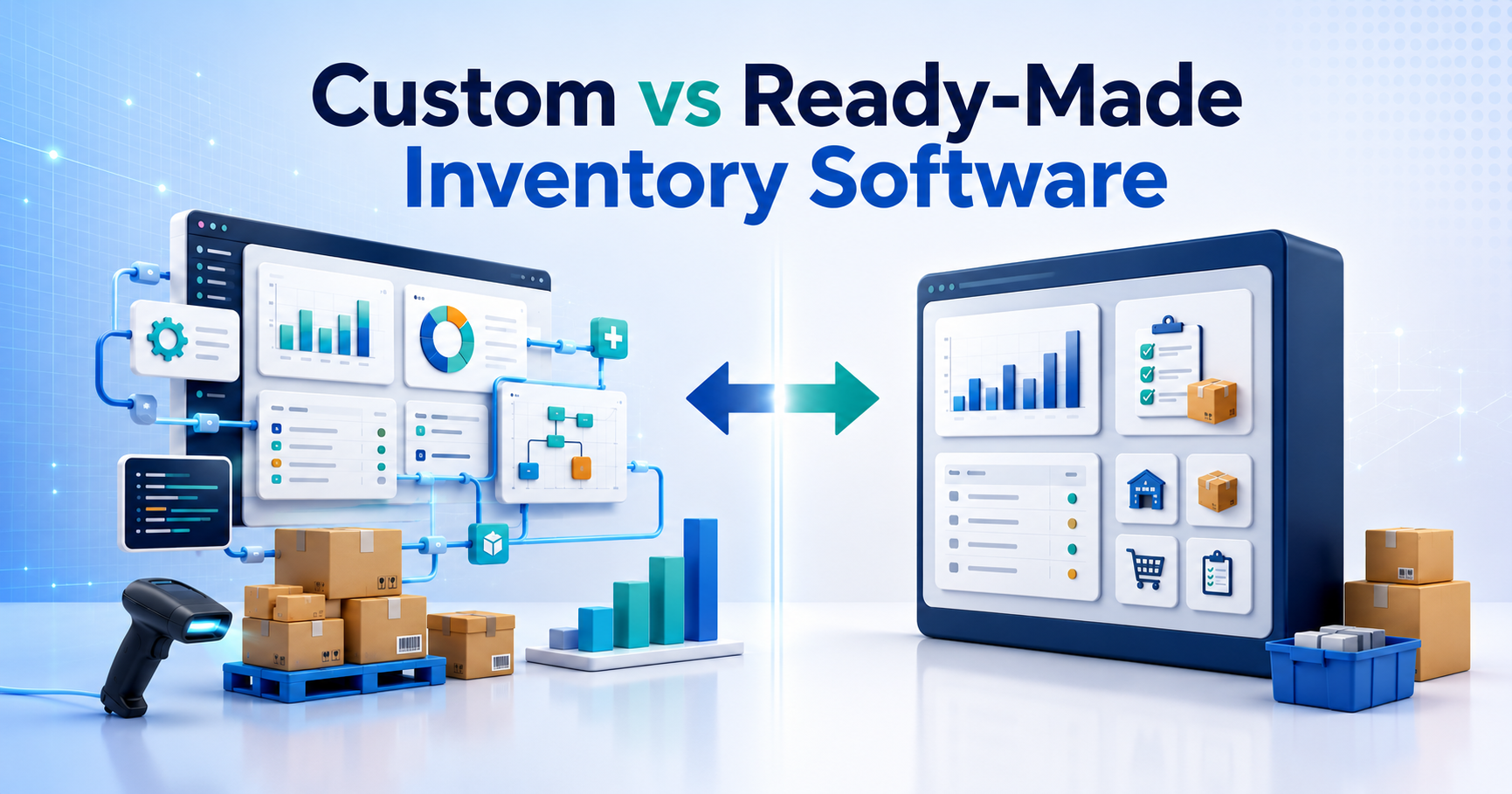
Custom vs Ready-Made Inventory Software: Which One Is Better
Efficient inventory management is essential for businesses that sell, store, or distribute products. As operations grow, manually tracking stock through spreadsheets can cause incorrect records, delayed orders, excess inventory, and missed sales.
Inventory management software solves these problems by bringing stock, orders, suppliers, and reports into one system. However, businesses must choose between custom inventory software and a ready-made solution. Both options have benefits, but the right choice depends on the company’s workflow, budget, and future plans.
What Is Ready-Made Inventory Software?
Ready-made inventory software is a pre-built system created for general business requirements. It normally provides common features such as stock tracking, purchase orders, low-stock alerts, supplier records, user access, and standard reports.
Because the software is already available, businesses can purchase a subscription, configure their accounts, add products, and start using it quickly. It is often suitable for startups and small businesses with straightforward inventory operations.
The main disadvantage is limited flexibility. A company may have to change its workflow according to the software. Specialized reports, approval processes, integrations, or industry-specific features may not be available.
What Is Custom Inventory Software?
Custom inventory software is developed according to the specific requirements of a business. Its features, design, permissions, reports, and workflows are planned around how the company actually manages inventory.
A custom inventory management system may include:
-
Real-time stock tracking
-
Barcode and QR code scanning
-
Multi-warehouse management
-
Purchase and supplier management
-
Low-stock and expiry alerts
-
Role-based employee access
-
Custom dashboards and reports
-
Integration with existing platforms
The software can also connect with CRM, ERP, accounting, e-commerce, payment, and shipping systems. This reduces duplicate data entry and keeps information consistent across departments.
Custom vs Ready-Made Inventory Software
Cost
Ready-made software usually requires a lower initial investment. However, monthly subscription costs may increase when a business adds more users, warehouses, storage, or advanced features.
Custom inventory software costs more initially because it must be planned, developed, and tested. Its long-term value can be higher because the business pays for useful features and gains greater control over future development.
Customization
Ready-made software provides standard tools for common inventory tasks. Customization is normally limited to the options offered by the provider.
Custom inventory software can be designed around specific products, locations, approval processes, departments, and reporting requirements. Features can also be updated when business needs change.
Implementation
A ready-made solution can be implemented quickly because its main features already exist. It is useful when a business urgently needs a basic inventory system.
Custom software takes longer because it involves requirement analysis, design, development, testing, data migration, and training. This process ensures that the final system supports the company’s actual workflow.
Integration
Standard inventory platforms generally support a limited list of popular applications. Connecting them with older or specialized business systems can be difficult.
Custom inventory software can be integrated with existing tools through APIs. This creates a connected system for inventory, sales, accounting, customer management, and order fulfilment.
Scalability
Ready-made software may work well for a small operation but become restrictive as products, users, orders, or locations increase.
A scalable custom inventory system can grow with the company. New warehouses, modules, automation rules, reports, and integrations can be added without replacing the complete platform.
Which Option Should You Choose?
Ready-made inventory software may be suitable when:
-
Inventory requirements are simple
-
The business has a limited budget
-
A system is needed immediately
-
Standard features are sufficient
-
Advanced integrations are unnecessary
Custom inventory software may be better when:
-
The business follows unique workflows
-
Multiple warehouses or locations are involved
-
Existing systems need to be connected
-
Specialized reports are required
-
The company expects long-term growth
Before selecting a solution, businesses should identify their current inventory problems, required features, number of users, integration needs, and expected future growth.
Why Choose Coding Rig?
Coding Rig develops custom inventory management software tailored to individual business operations. We first understand how the company manages products, orders, suppliers, warehouses, and employees. Based on these requirements, we create a secure and user-friendly solution.
Coding Rig can develop real-time inventory tracking, barcode integration, automated alerts, multi-location management, role-based access, custom reports, and third-party integrations. Each system is designed to reduce manual work, improve stock accuracy, and support future business growth.
From initial planning to development, deployment, and ongoing support, Coding Rig provides complete assistance at every stage of your inventory software journey.
Conclusion
Ready-made inventory software offers quick implementation and lower starting costs, making it suitable for simple operations. Custom inventory software provides greater flexibility, scalability, integration, and control.
The best option depends on how the business operates today and where it plans to grow. If standard software cannot support your requirements, Coding Rig can build a custom inventory solution designed around your workflow.
With the right inventory software, your business can reduce errors, save time, improve stock visibility, and make faster decisions.