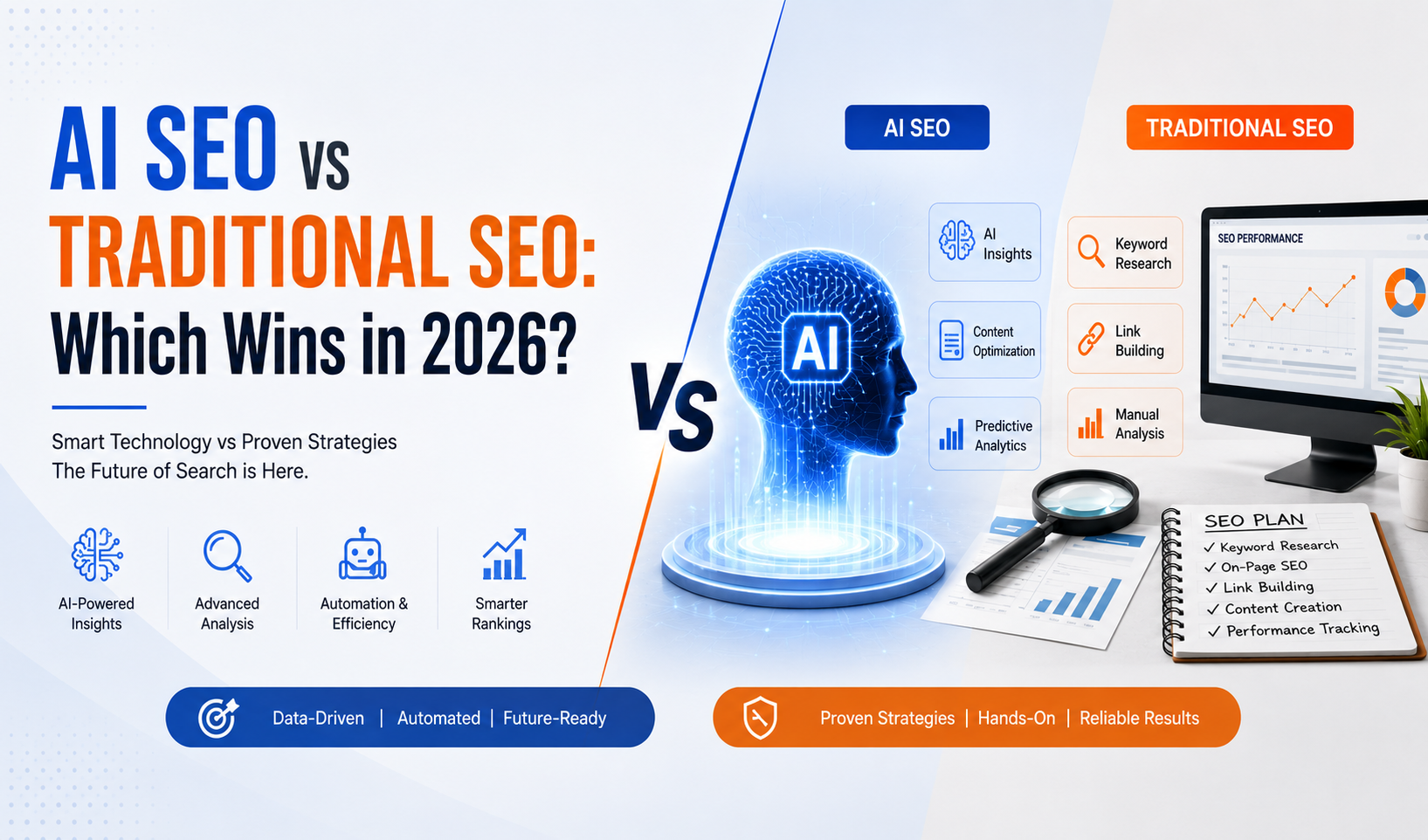
AI SEO vs Traditional SEO: Which Wins in 2026?
Search engine optimization is changing rapidly in 2026. Search is no longer limited to typing a few keywords into Google and clicking through a list of websites. People are increasingly using conversational queries, AI-powered search, voice search, and detailed questions to find information, products, and services.
This evolution has created a major question for businesses: AI SEO vs Traditional SEO — which strategy is better in 2026?
The answer is not about choosing one over the other. The most effective approach is to combine traditional SEO fundamentals with content strategies designed for modern AI-powered search.
What Is Traditional SEO?
Traditional SEO is the process of improving a website so search engines can understand its content, relevance, and structure.
It includes several important activities such as:
-
Keyword research
-
On-page optimization
-
Technical SEO
-
Internal linking
-
Backlink building
-
Meta titles and descriptions
-
Website speed optimization
-
Mobile optimization
-
Content optimization
For example, a company offering software development may optimize its website for terms such as custom software development, web development company, CRM software, and mobile app development.
The primary objective is to improve organic visibility and bring relevant visitors to the website.
What Is AI SEO?
AI SEO focuses on optimizing content for the changing search environment created by artificial intelligence.
Instead of focusing only on individual keywords, AI SEO puts greater emphasis on search intent, context, natural language, direct answers, topical authority, and useful information.
Consider the difference between these searches:
Traditional search:
"CRM software company"
Conversational search:
"What CRM software is best for a growing small business?"
The second query requires content that understands the user's actual problem and provides a meaningful answer.
This is where AI-focused content strategies become increasingly valuable.
AI SEO vs Traditional SEO: What's the Difference?
Traditional SEO is primarily focused on helping search engines discover, understand, and rank webpages.
AI SEO goes further by considering how information can be understood and used in AI-powered search experiences.
However, this does not mean traditional SEO is becoming outdated.
Technical SEO, crawlability, indexing, website structure, keywords, links, and high-quality content remain important foundations. AI-powered search still depends on reliable websites and useful information.
The difference is that modern SEO requires businesses to think beyond rankings and focus on how users search and what information they actually need.
Why Search Intent Matters More in 2026
One of the biggest changes in modern SEO is the importance of search intent.
A user searching for "website development" could be looking for a development company, pricing information, website ideas, or information about the development process.
Instead of creating a page that simply repeats the keyword, businesses should answer the questions behind the search.
Content should explain:
-
What the service provides
-
Who needs it
-
How it works
-
What it costs or what affects pricing
-
What benefits it provides
-
How to choose the right solution
This creates a better experience for users and gives search systems more useful information to understand.
Why Original Content Is Important
AI tools make it easier than ever to produce content. But producing content quickly does not automatically make it valuable.
Businesses need to provide something different from thousands of similar pages.
Original research, industry experience, real examples, case studies, expert opinions, statistics, and practical recommendations can make content more useful and trustworthy.
In 2026, the goal should not be to publish more content.
The goal should be to publish better content.
Technical SEO Still Builds the Foundation
AI SEO does not eliminate the need for technical SEO.
A website still needs to be:
-
Fast-loading
-
Mobile-friendly
-
Secure
-
Easy to navigate
-
Properly structured
-
Crawlable and indexable
-
Internally connected
A technically weak website can struggle to perform even if its content is excellent.
This is why businesses should treat technical SEO and AI-focused content as complementary strategies rather than competing approaches.
Which SEO Strategy Wins in 2026?
The real winner is a combined SEO strategy.
Traditional SEO provides the technical and structural foundation, while AI-focused optimization helps businesses create content that matches conversational searches and changing user behavior.
A strong 2026 strategy should combine:
Technical SEO + Search Intent + Quality Content + Brand Authority + AI-Ready Content
Businesses should also maintain consistent information across their website, social media, business profiles, and other relevant digital platforms.
How Coding Rig Can Help Your Business
At Coding Rig, we understand that successful digital marketing starts with a strong technology foundation.
Our services include web development, custom software development, mobile applications, CRM solutions, and digital marketing designed to help businesses build and grow their digital presence.
A modern business website should do more than look professional. It should provide a smooth user experience, load quickly, communicate clearly, and be structured to support long-term search visibility.
Whether your goal is to improve Google rankings, attract more customers, build brand authority, or prepare your business for AI-powered search, combining technology with a smart SEO strategy is essential.
Final Verdict
So, AI SEO vs Traditional SEO: Which Wins in 2026?
Neither one wins alone.
Traditional SEO remains the foundation of search visibility, while AI-focused SEO helps businesses adapt to the way people increasingly search and consume information.
The future of SEO is not about chasing algorithms. It is about building technically strong websites, understanding customer intent, creating original content, and delivering genuine value.
For businesses that adapt early, 2026 can be an opportunity to turn search visibility into stronger traffic, leads, and long-term growth.