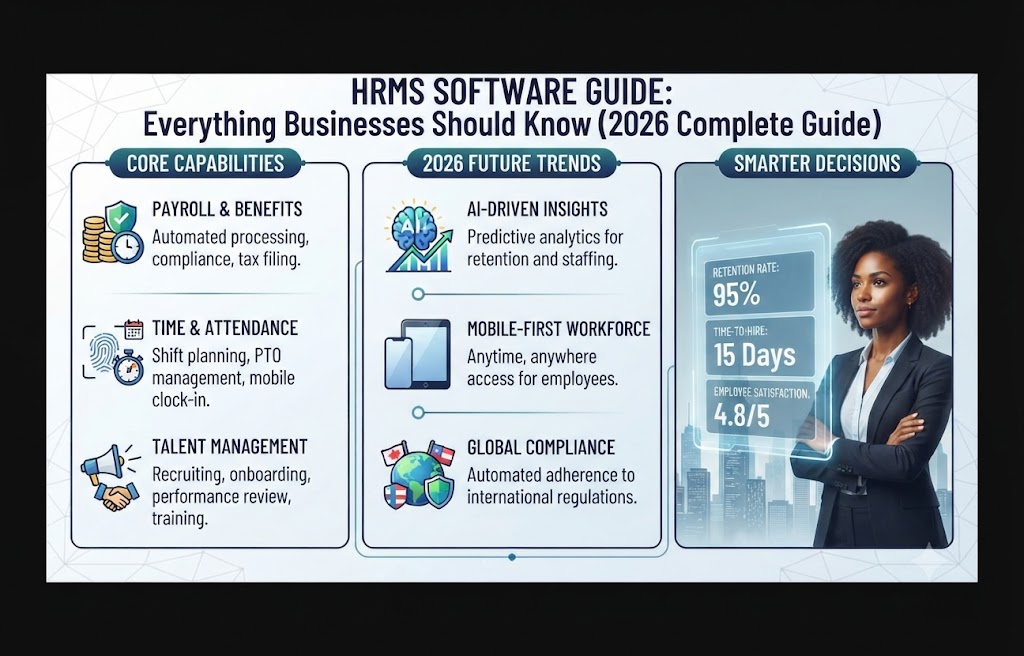
HRMS Software Guide: Everything Businesses Should Know (2026 Complete Guide)
Introduction
Managing employees efficiently is one of the biggest challenges for any growing business. HR teams handle recruitment, attendance, payroll, leave management, performance reviews, compliance, and employee engagement every day. When these tasks are managed manually, they often lead to errors, delays, and increased administrative workload.
A Human Resource Management System (HRMS) simplifies these processes by automating routine tasks and centralizing employee information in one secure platform. In 2026, HRMS software has become an essential business solution for startups, SMEs, and large enterprises looking to improve productivity, enhance employee experience, and streamline HR operations.
This guide explains what HRMS software is, its features, benefits, implementation tips, and the latest trends shaping workforce management.
What Is HRMS Software?
A Human Resource Management System (HRMS) is software that manages the complete employee lifecycle—from recruitment and onboarding to payroll, attendance, performance management, and employee records.
Instead of using multiple spreadsheets and disconnected tools, businesses can manage all HR activities from a single dashboard. Most modern HRMS platforms are cloud-based, allowing employees and managers to securely access information from anywhere.
Why HRMS Is Important in 2026
Today's workplaces are more dynamic than ever, with remote work, hybrid teams, and growing compliance requirements. HRMS software helps organizations manage these challenges through automation and real-time data.
Key advantages include:
-
Reduced manual HR tasks
-
Accurate payroll processing
-
Better employee engagement
-
Simplified compliance
-
Improved workforce planning
-
Faster decision-making
-
Higher operational efficiency
By automating routine work, HR professionals can focus on employee development and business strategy.
Essential Features of HRMS Software
A modern HRMS includes multiple integrated modules designed to simplify HR management.
Employee Management
Maintain centralized employee records, including personal details, documents, employment history, and organizational roles.
Recruitment & Applicant Tracking
Post job openings, manage applications, schedule interviews, and monitor the hiring process from a single platform.
Attendance & Leave Management
Track attendance, manage shifts, approve leave requests, and monitor employee availability in real time.
Payroll Management
Automate salary calculations, tax deductions, bonuses, reimbursements, overtime, and generate digital payslips accurately.
Performance Management
Set goals, conduct appraisals, monitor employee progress, and provide continuous performance feedback.
Employee Self-Service
Allow employees to update personal information, download payslips, apply for leave, and access company policies without depending on HR for routine requests.
Reports & Analytics
Generate reports on attendance, payroll, recruitment, employee turnover, and workforce performance to support data-driven decisions.
Benefits of HRMS Software
Implementing an HRMS offers several business benefits:
-
Increased productivity through automation
-
Accurate and timely payroll
-
Improved employee satisfaction
-
Better compliance with labor regulations
-
Secure storage of employee data
-
Faster HR processes
-
Real-time workforce insights
-
Reduced administrative costs
These benefits help organizations operate more efficiently while creating a better employee experience.
Industries Using HRMS Software
HRMS solutions are widely used across industries, including:
-
Information Technology
-
Healthcare
-
Manufacturing
-
Retail
-
Education
-
Hospitality
-
Banking & Finance
-
Logistics
-
Construction
-
Government
-
Startups and SMEs
Any organization managing employees can benefit from HR automation.
HRMS vs Traditional HR Management
Traditional HR systems often rely on spreadsheets, paper documents, and multiple software applications, resulting in:
-
Manual data entry
-
Payroll errors
-
Slow approvals
-
Lost documents
-
Compliance risks
-
Limited reporting
HRMS software replaces these outdated processes with a centralized digital platform that improves efficiency, transparency, and accuracy.
Best Practices for HRMS Implementation
To successfully implement HRMS software:
-
Define business requirements
-
Choose scalable software
-
Migrate employee data securely
-
Train HR teams and employees
-
Configure user roles and permissions
-
Integrate payroll and attendance systems
-
Test workflows before launch
-
Monitor system performance regularly
Proper implementation ensures a smooth transition and long-term success.
HRMS Trends in 2026
HR technology continues to evolve with AI and automation. Major trends include:
-
AI-powered recruitment
-
Predictive workforce analytics
-
Automated employee onboarding
-
Chatbot-based HR support
-
Mobile-first HR applications
-
Facial recognition attendance
-
Employee wellness tracking
-
Skills and learning management
-
Cloud-based HR platforms
-
Personalized employee experiences
These innovations help businesses build more efficient and future-ready workplaces.
Why Choose Coding Rig?
At Coding Rig, we develop customized HRMS software tailored to your business needs. Our solutions include employee management, payroll automation, attendance tracking, leave management, recruitment, performance evaluation, document management, reporting dashboards, mobile accessibility, and role-based security.
We also integrate HRMS with ERP systems, accounting software, biometric devices, CRM platforms, and Business Intelligence tools to create a connected digital workplace. Every solution is built for scalability, security, and long-term business growth.
Conclusion
HRMS software has become an essential investment for businesses seeking to modernize their HR operations. By automating repetitive tasks, improving payroll accuracy, enhancing employee engagement, and providing valuable workforce insights, HRMS helps organizations operate more efficiently.
As businesses continue embracing digital transformation in 2026, adopting the right HRMS solution can improve productivity, simplify compliance, and support sustainable growth. Whether you're a startup or a large enterprise, investing in HRMS software is a smart step toward building a more efficient, data-driven, and employee-focused organization.