Business Intelligence (BI): How Data Helps Businesses Make Smarter Decisions (2026 Guide)
Introduction
Data has become one of the most valuable assets for modern businesses. Every customer interaction, online purchase, website visit, marketing campaign, and financial transaction generates information that can help organizations improve their performance. However, collecting data alone isn't enough—businesses need the ability to transform it into meaningful insights. This is where Business Intelligence (BI) plays a vital role.
Business Intelligence enables companies to collect, organize, analyze, and visualize data to support smarter, faster, and more informed decisions. Whether you're running a startup, an eCommerce business, a manufacturing company, or a large enterprise, BI helps improve efficiency, identify opportunities, and drive sustainable growth.
This guide explains Business Intelligence, its components, benefits, business applications, and why it has become essential in 2026.
What Is Business Intelligence (BI)?
Business Intelligence (BI) is a combination of technologies, software, and processes that convert raw business data into meaningful reports, dashboards, and visual insights.
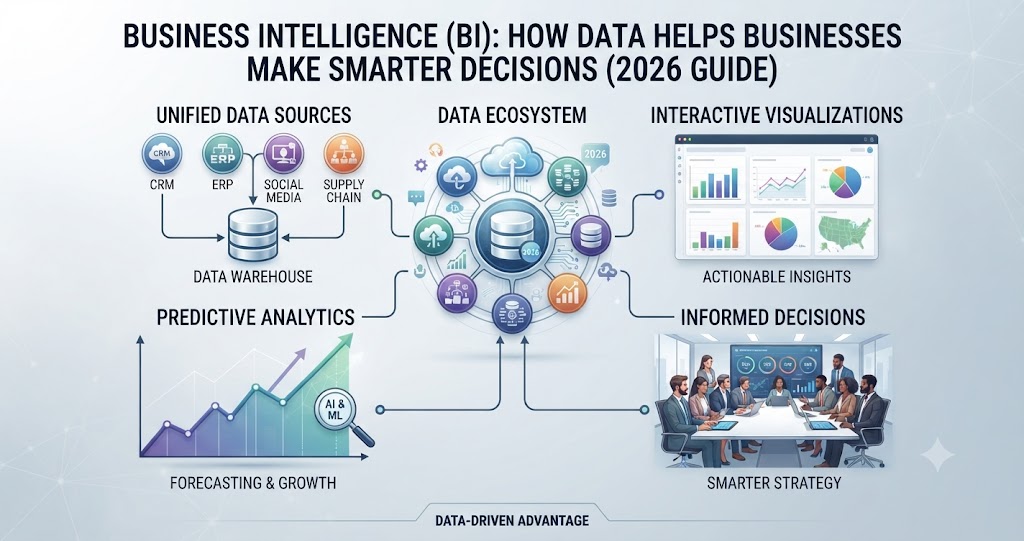
A BI system gathers information from multiple sources such as CRM software, ERP systems, accounting platforms, HRMS software, inventory systems, websites, and cloud databases. It then organizes and presents the data in an easy-to-understand format, allowing business leaders to monitor performance and make data-driven decisions.
Instead of relying on spreadsheets or assumptions, organizations gain access to real-time business insights.
Why Business Intelligence Matters
Today's businesses operate in a highly competitive and data-driven environment. Making decisions based on outdated reports or guesswork can lead to missed opportunities and operational inefficiencies.
Business Intelligence helps organizations:
-
Make faster decisions
-
Improve operational efficiency
-
Track business performance
-
Identify market trends
-
Increase customer satisfaction
-
Reduce operational costs
-
Improve forecasting
-
Support long-term growth
Companies that use real-time insights can respond quickly to market changes and customer needs.
Core Components of Business Intelligence
A modern BI solution consists of several important elements.
Data Collection
Business data is collected from multiple sources, including sales systems, marketing platforms, finance software, websites, inventory management, and customer databases.
Data Integration
Information from different systems is cleaned, organized, and combined into a centralized database to ensure consistency and accuracy.
Data Analysis
Advanced analytics identify patterns, trends, and relationships that help businesses understand performance and predict future outcomes.
Dashboards & Reports
Interactive dashboards display important KPIs, charts, and graphs, making complex information easy to understand.
Performance Monitoring
Business leaders can continuously monitor operations and respond quickly to changes using real-time reporting.
How Business Intelligence Helps Different Departments
Business Intelligence improves decision-making across every department.
Sales
Track revenue, sales performance, customer acquisition, and conversion rates to identify growth opportunities.
Marketing
Measure campaign performance, website traffic, lead generation, and return on investment (ROI) to improve marketing strategies.
Finance
Monitor budgets, expenses, cash flow, profitability, and financial forecasts through real-time dashboards.
Human Resources
Analyze employee performance, recruitment, attendance, workforce productivity, and training effectiveness.
Operations
Monitor production, inventory, supply chain performance, warehouse operations, and quality control to improve efficiency.
Benefits of Business Intelligence
Organizations implementing BI experience significant business improvements, including:
-
Faster decision-making
-
Better forecasting
-
Improved productivity
-
Increased operational efficiency
-
Enhanced customer experiences
-
Reduced business costs
-
Real-time reporting
-
Better collaboration
-
Higher revenue opportunities
-
Data-driven strategic planning
These benefits help businesses become more competitive while improving overall performance.
Business Intelligence vs Traditional Reporting
Traditional reporting relies on static spreadsheets and manually prepared reports that often become outdated quickly.
Business Intelligence provides dynamic dashboards that update automatically as new information becomes available. Users can explore data in real time, identify trends instantly, and make faster decisions based on accurate information.
This makes BI significantly more effective than traditional reporting methods.
Business Intelligence Trends in 2026
Business Intelligence continues evolving with modern technologies. Key trends include:
-
AI-powered predictive analytics
-
Self-service BI platforms
-
Cloud-based dashboards
-
Natural language reporting
-
Mobile Business Intelligence
-
Automated data visualization
-
Machine learning insights
-
Embedded analytics
-
Real-time business monitoring
-
Interactive KPI dashboards
These innovations allow businesses to analyze data faster while reducing manual effort.
Best Practices for Implementing Business Intelligence
To maximize the value of BI, businesses should:
-
Define clear business goals
-
Collect high-quality data
-
Integrate all major business systems
-
Monitor KPIs regularly
-
Build interactive dashboards
-
Protect sensitive business data
-
Train employees on BI tools
-
Continuously improve reporting strategies
Following these practices ensures reliable insights and better business outcomes.
Why Choose Coding Rig?
At Coding Rig, we develop customized Business Intelligence solutions that help organizations transform business data into actionable insights. Our services include real-time dashboards, KPI monitoring, cloud-based analytics, custom reporting, data visualization, and Business Intelligence integration.
We connect BI platforms with ERP, CRM, HRMS, accounting software, inventory management systems, and other business applications to create centralized dashboards that simplify decision-making and improve operational performance.
Our scalable BI solutions help businesses improve efficiency, identify growth opportunities, and build a data-driven future.
Conclusion
Business Intelligence has become a critical tool for businesses seeking to make smarter and faster decisions. By converting raw business data into meaningful insights, BI helps organizations improve productivity, reduce costs, optimize operations, and identify new opportunities for growth.
As digital transformation continues in 2026, businesses that leverage Business Intelligence will gain a significant competitive advantage. Investing in the right BI solution enables organizations to make confident decisions, improve customer experiences, and achieve long-term business success in an increasingly data-driven world.