Cloud Migration Guide for Businesses (2026)
Introduction
Cloud migration has become one of the most important steps in modern digital transformation. Businesses are moving away from traditional on-premise servers and adopting cloud platforms to improve flexibility, security, and operational efficiency. Whether you're a startup, an SME, or a large enterprise, migrating to the cloud helps reduce infrastructure costs while preparing your business for future growth.
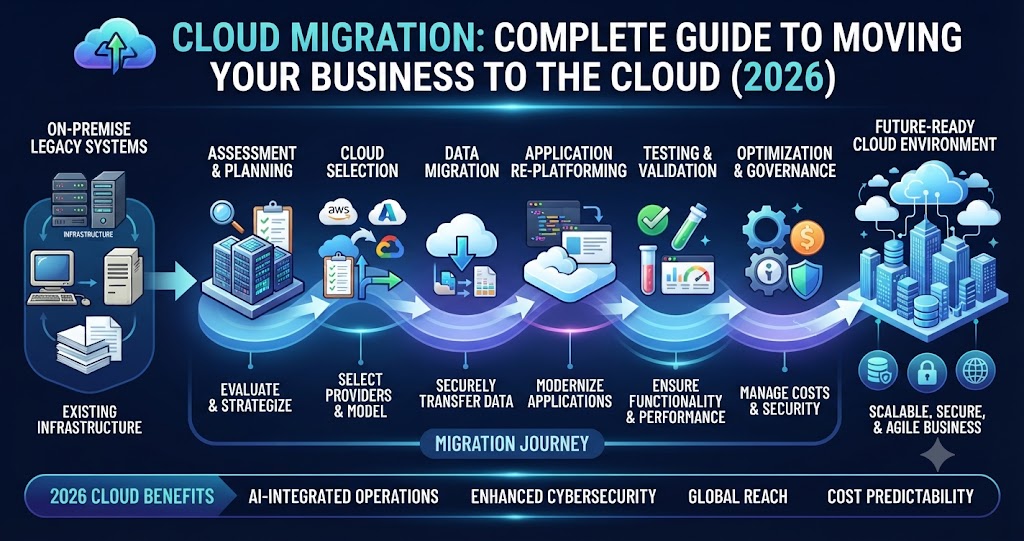
However, cloud migration is more than simply moving data from one server to another. A successful migration requires proper planning, secure data transfer, application optimization, and continuous monitoring to ensure long-term performance.
This guide explains cloud migration, its benefits, migration strategies, challenges, and best practices to help businesses transition to the cloud successfully.
What Is Cloud Migration?
Cloud migration is the process of moving applications, databases, files, workloads, and IT infrastructure from physical servers or legacy systems to cloud environments.
Organizations may migrate to:
-
Public Cloud
-
Private Cloud
-
Hybrid Cloud
-
Multi-Cloud Infrastructure
The primary objective is to improve scalability, strengthen security, reduce operational costs, and provide greater flexibility for business operations.
Why Businesses Are Moving to the Cloud
Modern businesses require systems that support remote work, rapid growth, and continuous innovation. Traditional infrastructure often struggles to meet these demands due to high maintenance costs and limited scalability.
Cloud technology provides:
-
On-demand computing resources
-
Flexible infrastructure
-
Automatic updates
-
Remote accessibility
-
Better business continuity
-
Faster deployment
-
Pay-as-you-go pricing
These advantages make cloud computing a preferred choice for organizations across every industry.
Benefits of Cloud Migration
Migrating to the cloud offers numerous business advantages.
Lower IT Costs
Businesses eliminate expenses related to hardware purchases, maintenance, electricity, cooling, and server upgrades while paying only for the resources they use.
Better Scalability
Cloud platforms allow businesses to increase or decrease computing resources instantly based on demand without investing in additional hardware.
Improved Security
Leading cloud providers offer encryption, multi-factor authentication, identity management, automated backups, and advanced threat protection to safeguard business data.
Business Continuity
Built-in backup and disaster recovery capabilities help organizations recover quickly from unexpected failures or cyber incidents.
Remote Accessibility
Employees can securely access applications and business data from anywhere, making cloud computing ideal for hybrid and remote work environments.
Faster Innovation
Cloud infrastructure enables faster application deployment, software testing, and feature updates, allowing businesses to respond quickly to market changes.
Cloud Migration Strategies
Businesses can choose different migration approaches depending on their goals.
Rehosting (Lift and Shift)
Applications are moved to the cloud with minimal modifications. This is the quickest migration method.
Replatforming
Applications receive minor improvements to perform better in cloud environments without major redevelopment.
Refactoring
Applications are redesigned using cloud-native architecture to improve scalability, flexibility, and long-term performance.
Replacing
Legacy applications are replaced with modern cloud-based SaaS solutions that require less maintenance.
Selecting the right strategy depends on your business requirements, budget, and existing infrastructure.
Common Cloud Migration Challenges
Although cloud migration offers significant benefits, businesses may encounter challenges such as:
-
Data security concerns
-
Legacy application compatibility
-
Unexpected downtime
-
Integration with existing systems
-
Cloud cost management
-
Compliance requirements
-
Employee training
-
Data migration complexity
A well-planned migration strategy helps minimize these risks.
Best Practices for Successful Cloud Migration
For a smooth cloud migration, businesses should:
-
Assess current IT infrastructure
-
Define migration goals
-
Prioritize critical applications
-
Encrypt sensitive data
-
Back up all business information
-
Test applications after migration
-
Monitor cloud performance continuously
-
Optimize cloud resource usage
-
Train employees on cloud technologies
Following these practices ensures a secure and efficient migration process.
Cloud Migration Trends in 2026
Cloud technology continues to evolve with innovations such as:
-
AI-powered cloud management
-
Hybrid and multi-cloud environments
-
Serverless computing
-
Edge computing
-
Cloud-native applications
-
Automated cloud security
-
Predictive resource optimization
-
Green cloud infrastructure
-
Intelligent workload management
-
Cloud-based AI services
These technologies help businesses improve performance while reducing operational complexity.
Why Choose Coding Rig?
At Coding Rig, we help businesses migrate to the cloud safely and efficiently. Our cloud migration services include infrastructure assessment, migration planning, application modernization, database migration, cloud security implementation, backup and disaster recovery, API integration, cloud optimization, and ongoing support.
Whether you're migrating websites, ERP systems, CRM software, eCommerce platforms, custom business applications, or enterprise workloads, our team delivers secure, scalable, and future-ready cloud solutions tailored to your business goals.
Conclusion
Cloud migration is no longer just an IT upgrade—it's a strategic investment that helps businesses become more agile, secure, and competitive. By moving applications and data to the cloud, organizations benefit from lower operational costs, improved scalability, stronger security, and greater flexibility.
As cloud adoption continues to accelerate in 2026, businesses with a well-planned migration strategy will be better positioned to innovate, improve customer experiences, and support long-term digital growth. Investing in cloud migration today lays the foundation for a smarter, more efficient, and future-ready business.