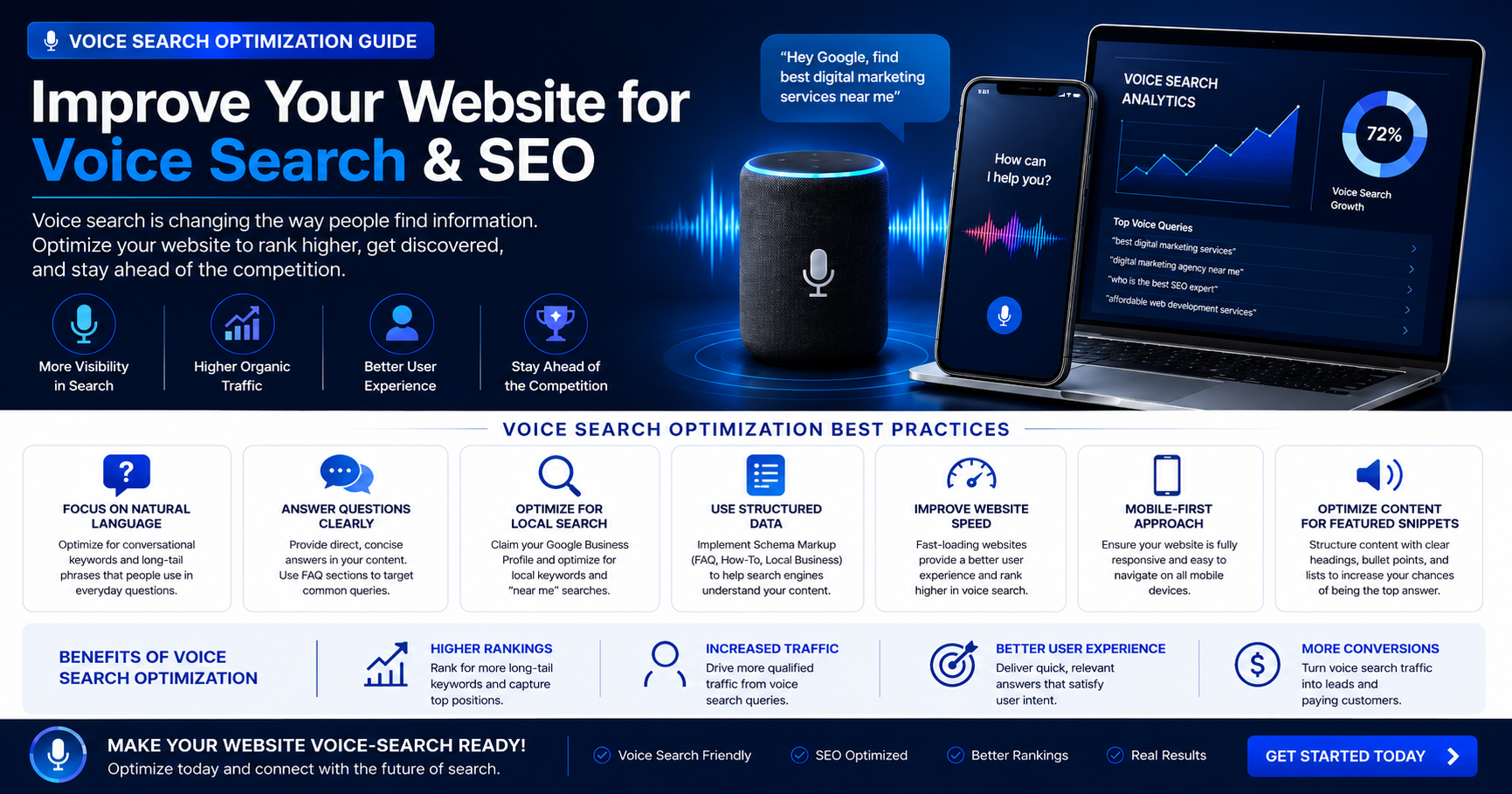
Voice Search Optimization Guide: How to Optimize Your Website for Voice Search in 2026
Search behavior has changed dramatically over the last few years. Instead of typing short keywords, people now ask complete questions using smartphones, smart speakers, and AI-powered assistants. Voice search has become a natural way to find local businesses, products, services, and information. As this trend continues to grow in 2026, businesses that optimize for voice search gain a significant competitive advantage.
Voice Search Optimization is the process of improving your website so it can understand and answer conversational queries. When combined with strong SEO practices, it helps businesses increase visibility, attract qualified visitors, and improve customer engagement.
What Is Voice Search Optimization?
Voice Search Optimization (VSO) is the practice of designing website content to match the way people speak rather than how they type. Voice searches are usually longer, more conversational, and often phrased as questions.
For example, instead of typing "best software company Mohali," users might ask, "Which is the best software development company near me?"
Optimizing your website for these natural-language searches increases the chances of appearing in voice search results and AI-generated answers.
Why Voice Search Matters
More people now rely on voice assistants to search for businesses, compare products, and find quick answers. Since voice searches usually return only a few highly relevant results, businesses with optimized content have a better opportunity to gain visibility.
Voice search optimization helps businesses:
-
Improve online visibility
-
Increase organic traffic
-
Enhance user experience
-
Reach mobile users
-
Support local SEO
-
Improve conversion opportunities
It also prepares your website for AI-powered search engines that prioritize direct, high-quality answers.
Best Practices for Voice Search SEO
Focus on Conversational Keywords
Voice searches sound like normal conversations. Instead of targeting only short keywords, include longer phrases and natural questions throughout your content.
Examples include:
-
What is the best website development company?
-
How much does website development cost in 2026?
These question-based keywords align with how users interact with voice assistants.
Create Helpful FAQ Sections
Frequently Asked Questions are highly effective for voice search because they provide direct answers to common user queries.
Keep answers concise, informative, and easy to understand. Well-structured FAQ sections also improve your chances of appearing in featured snippets.
Improve Website Speed
Fast websites create better user experiences and are more likely to rank well in search results. Compress images, optimize code, enable caching, and use a Content Delivery Network (CDN) to improve loading times.
Website performance remains an important ranking factor for both SEO and voice search.
Optimize for Mobile Devices
Most voice searches happen on smartphones. A responsive website with easy navigation, readable content, and fast loading speeds provides a better experience for mobile users.
Strengthen Local SEO
Many voice searches include phrases like "near me" or "closest." Businesses should optimize their Google Business Profile, maintain accurate contact information, and include location-specific keywords where appropriate.
Consistent business details across all online platforms improve local search visibility.
Voice Search and AI Search
Voice search and AI-powered search engines share a common goal—providing users with accurate answers quickly.
Businesses should focus on creating content that:
-
Answers real customer questions
-
Uses simple, natural language
-
Includes clear headings
-
Provides helpful explanations
-
Covers topics comprehensively
-
Demonstrates expertise and trustworthiness
This approach supports both traditional SEO and modern AI search experiences.
Technical Optimization Tips
Technical improvements also play an important role in voice search success.
Recommended practices include:
-
Implement structured data (Schema Markup)
-
Use HTTPS for website security
-
Optimize Core Web Vitals
-
Improve page loading speed
-
Create SEO-friendly URLs
-
Add image alt text
-
Build a clear internal linking structure
These improvements help search engines understand your website more effectively.
Why Choose Coding Rig?
At Coding Rig, we develop websites that are built for the future of search. Our team combines modern web development, technical SEO, UI/UX design, Core Web Vitals optimization, and voice search strategies to create high-performing websites that deliver measurable business results.
Whether you need a corporate website, custom software, eCommerce platform, CRM, ERP solution, or mobile application, we build secure, responsive, and SEO-friendly digital solutions that help businesses stay competitive in an AI-driven world.
Conclusion
Voice search is no longer a future trend—it is becoming a standard way people interact with technology. Businesses that optimize their websites for conversational search, mobile performance, and user experience are better positioned to attract customers and improve search visibility.
By combining voice search optimization with strong SEO, fast website performance, and high-quality content, your business can reach more users, earn higher rankings, and stay ahead of changing search behaviors in 2026 and beyond.