SaaS Development Guide: How to Build a Successful Cloud Software Product (2026)
Software has evolved far beyond traditional desktop applications. Today, businesses and consumers expect software that is accessible from anywhere, updates automatically, scales effortlessly, and requires no complex installation. This shift has made Software as a Service (SaaS) one of the fastest-growing segments in the technology industry.
From customer relationship management and project management to accounting, healthcare, education, and eCommerce, SaaS applications have become the preferred choice for organizations worldwide. Businesses benefit from lower infrastructure costs, automatic updates, subscription-based pricing, and seamless accessibility across devices.
However, building a successful SaaS product involves much more than writing code. It requires market research, thoughtful product planning, scalable architecture, strong security, intuitive user experiences, and continuous improvement.
This guide explains everything you need to know about SaaS development in 2026, including planning, architecture, essential features, development process, and best practices for creating a cloud-based software product that users love.
What is SaaS?
Software as a Service (SaaS) is a cloud-based software delivery model where users access applications through a web browser or mobile app instead of installing software on their local computers.
The software is hosted on cloud servers and maintained by the service provider, while customers subscribe through monthly or annual plans.
Popular SaaS products include CRM platforms, HR management systems, project management tools, accounting software, learning management systems, email marketing platforms, collaboration tools, and inventory management solutions.
This model enables businesses to provide software that is always available, continuously updated, and accessible from virtually anywhere.
Why SaaS Is Growing Rapidly in 2026
Businesses continue moving away from expensive on-premise software because cloud-based platforms offer greater flexibility and lower operational costs.
Organizations choose SaaS because it provides:
- Easy accessibility from any device
- Automatic software updates
- Lower infrastructure expenses
- Subscription-based pricing
- Faster deployment
- Better scalability
- Remote collaboration
- Improved business continuity
As remote work, cloud computing, and AI adoption continue expanding, SaaS solutions have become essential for businesses of every size.
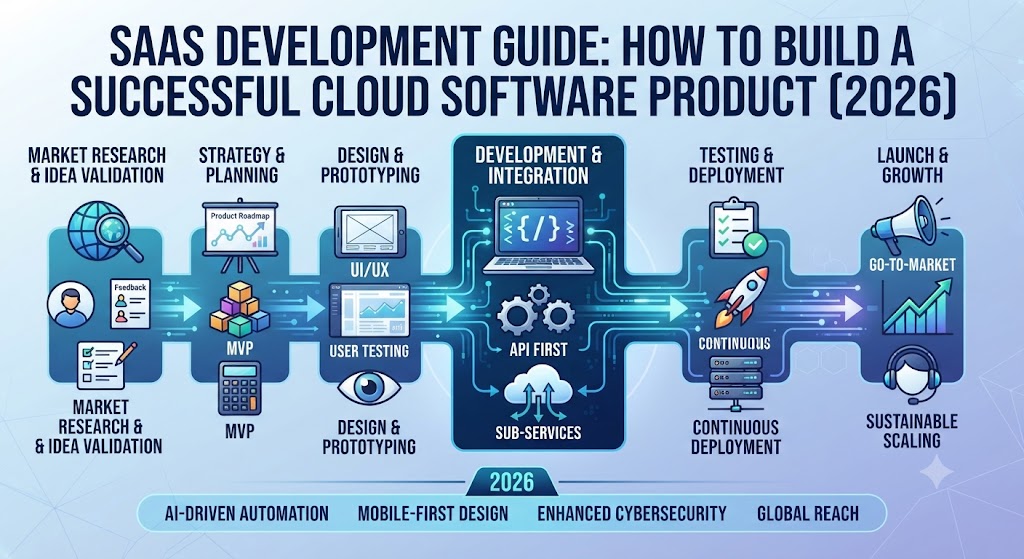
Key Steps to Build a Successful SaaS Product
Creating a successful SaaS application requires a structured development strategy.
Identify a Real Business Problem
The best SaaS products solve specific business challenges. Before writing code, identify problems experienced by your target audience and understand how your solution will simplify their work.
Conduct market research, interview potential users, and analyze competitors to validate your idea.
Define Your Target Audience
Not every SaaS product serves every business.
Clearly identify your ideal customers based on:
- Industry
- Company size
- Business goals
- Technical requirements
- Daily challenges
- Budget
- Growth potential
Understanding your audience helps shape both product features and marketing strategies.
Build a Minimum Viable Product (MVP)
Launching with a Minimum Viable Product allows businesses to validate ideas quickly while reducing development costs.
An MVP includes only the core features necessary to solve the primary problem.
After gathering customer feedback, additional functionality can be introduced through future updates.
This approach reduces risk while accelerating product launches.
Essential Features Every SaaS Product Needs
Although every SaaS platform is unique, certain features are considered essential.
Secure User Authentication
Users should be able to register, log in securely, reset passwords, and enable multi-factor authentication.
Strong authentication protects both business and customer data.
Subscription and Billing Management
Most SaaS businesses operate using recurring subscription models.
The platform should support:
- Monthly subscriptions
- Annual plans
- Free trials
- Coupon management
- Payment gateways
- Automated invoicing
- Renewal reminders
User Dashboard
An intuitive dashboard gives users quick access to important information, reports, notifications, and account settings.
Simple navigation significantly improves user satisfaction.
Role-Based Access Control
Different users often require different permission levels.
Administrators, managers, employees, and customers should only access information relevant to their responsibilities.
Analytics and Reporting
Business intelligence features help users measure performance through:
- Interactive dashboards
- Charts
- Reports
- Export functionality
- Performance metrics
- Activity logs
Data-driven insights increase the overall value of the software.
API Integration
Modern SaaS applications rarely operate independently.
API integration enables seamless communication with:
- CRM software
- ERP systems
- Accounting platforms
- Payment gateways
- Marketing tools
- Cloud storage
- Email services
- Communication platforms
Connected systems improve workflow automation.
Importance of Cloud Infrastructure
Cloud infrastructure forms the backbone of every SaaS platform.
Using cloud services allows businesses to:
- Scale resources automatically
- Maintain high availability
- Improve application performance
- Secure customer information
- Reduce hardware investments
- Support global users
Cloud-native architecture also simplifies future expansion.
Security Best Practices for SaaS Applications
Security remains one of the most important aspects of SaaS development.
Organizations should implement:
- HTTPS encryption
- Data encryption
- Multi-factor authentication
- Secure APIs
- Automated backups
- Firewall protection
- Activity monitoring
- Access control
- Regular vulnerability assessments
- Compliance with privacy regulations
Protecting customer data builds trust and strengthens long-term business relationships.
Benefits of SaaS Development
Developing a SaaS product offers advantages for both software providers and customers.
Some major benefits include:
- Recurring subscription revenue
- Global accessibility
- Automatic software updates
- Lower maintenance costs
- Faster feature deployment
- Better customer retention
- Easy scalability
- Improved collaboration
- Centralized data management
- Continuous product improvement
These advantages explain why SaaS continues dominating the software industry.
Emerging SaaS Trends in 2026
Technology continues reshaping cloud software.
Important SaaS trends include:
- AI-powered automation
- Predictive analytics
- No-code customization
- Low-code workflows
- Embedded Business Intelligence
- Cloud-native architecture
- Multi-cloud deployment
- Real-time collaboration
- Voice-enabled interfaces
- Advanced cybersecurity
- Personalized user experiences
Businesses adopting these innovations remain more competitive in rapidly changing markets.
Common Challenges in SaaS Development
Building cloud software also presents several technical and business challenges.
These include:
- Choosing the right technology stack
- Ensuring scalability
- Managing subscription billing
- Data security
- Performance optimization
- Customer onboarding
- Multi-tenant architecture
- API management
- Ongoing feature development
- Customer support
A structured development process helps overcome these challenges efficiently.
How Coding Rig Builds Modern SaaS Applications
At Coding Rig, we specialize in developing secure, scalable, and high-performance SaaS applications tailored to modern business requirements. From product strategy and UI/UX design to cloud architecture, API integration, payment systems, and deployment, we provide end-to-end SaaS development services.
Our team builds cloud software for industries including healthcare, education, logistics, finance, manufacturing, retail, real estate, HR, and enterprise management. Every solution is designed with scalability, security, performance, and user experience in mind.
Whether you're launching a startup SaaS platform or modernizing an existing business application, we help transform innovative ideas into successful cloud-based software products.
Conclusion
SaaS development has become one of the most effective ways to deliver scalable, accessible, and future-ready software. Businesses increasingly prefer cloud-based solutions because they reduce infrastructure costs, improve collaboration, simplify updates, and provide users with seamless experiences across devices.
Creating a successful SaaS product requires much more than technical expertise. It involves understanding customer needs, building secure and scalable architecture, delivering intuitive user experiences, and continuously improving the platform based on real-world feedback.
As cloud computing and Artificial Intelligence continue shaping the future of software in 2026, organizations investing in well-designed SaaS products will be better positioned to innovate, expand globally, and build long-term customer relationships. With the right strategy, technology, and development partner, a SaaS application can become a powerful engine for sustainable business growth.