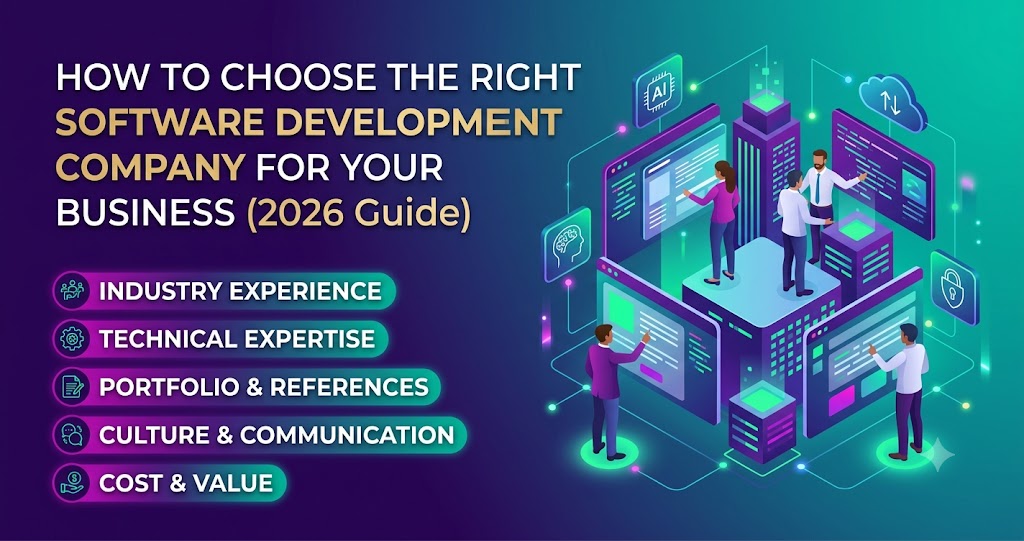
How to Choose the Right Software Development Company for Your Business (2026 Guide)
Introduction
Technology has become the backbone of modern businesses. Whether you're building a custom software solution, business website, mobile application, SaaS platform, ERP, CRM, or AI-powered application, choosing the right software development company is one of the most important decisions you'll make.
The right development partner doesn't just write code—they understand your business objectives, recommend the best technologies, create scalable solutions, and provide long-term support that helps your business grow.
On the other hand, selecting the wrong company can result in project delays, poor software quality, security issues, budget overruns, and costly redevelopment.
This guide explains everything you need to know about choosing the right software development company, including evaluation criteria, important questions to ask, common mistakes to avoid, and best practices for ensuring project success.
Why Choosing the Right Software Development Company Matters
Software is a long-term investment that directly impacts business operations, customer experience, and revenue.
A reliable software development company helps you:
- Build scalable solutions
- Reduce development risks
- Deliver projects on time
- Maintain high security standards
- Provide ongoing support
- Improve software quality
- Accelerate digital transformation
Choosing the right partner saves both time and money over the life of your project.
Define Your Business Requirements First
Before approaching any software company, clearly identify your business goals.
Ask yourself:
- What problem should the software solve?
- Who will use the system?
- What features are essential?
- What is your estimated budget?
- What is your expected timeline?
- Do you need a website, mobile app, web application, or enterprise software?
Having clear requirements makes it easier to evaluate development companies and receive accurate project estimates.
Look for Relevant Industry Experience
Every industry has unique workflows and compliance requirements.
A software company with experience in your sector can better understand your challenges and recommend practical solutions.
Industries include:
- Healthcare
- Finance
- Retail
- Manufacturing
- Logistics
- Education
- Hospitality
- Real Estate
- E-commerce
- Professional Services
Industry expertise often leads to faster development and fewer revisions.
Review Their Portfolio
A company's portfolio provides insight into its technical capabilities and design quality.
Look for projects involving:
- Business websites
- Mobile applications
- SaaS platforms
- CRM systems
- ERP solutions
- AI applications
- E-commerce platforms
- Cloud solutions
Pay attention to usability, performance, and the variety of industries served.
Evaluate Technical Expertise
Technology evolves quickly, so choose a company with expertise in modern development tools and frameworks.
Areas to consider include:
Frontend Development
- React
- Angular
- Vue.js
Backend Development
- Laravel
- Node.js
- .NET
- Python
- Java
Mobile Development
- Flutter
- React Native
- Native Android
- Native iOS
Cloud Platforms
- AWS
- Microsoft Azure
- Google Cloud
Databases
- MySQL
- PostgreSQL
- MongoDB
A versatile technical team can recommend the best solution for your specific needs.
Check Communication and Project Management
Successful software projects rely on clear communication.
A professional development company should provide:
- Regular progress updates
- Transparent timelines
- Dedicated project managers
- Agile development processes
- Clear documentation
- Collaborative planning
Strong communication reduces misunderstandings and keeps projects on schedule.
Understand Their Development Process
Ask about their software development lifecycle.
A structured process usually includes:
- Requirement analysis
- Planning
- UI/UX design
- Development
- Testing
- Deployment
- Maintenance
Companies with well-defined workflows are more likely to deliver consistent results.
Assess Security Practices
Security should be built into every software project.
Ask whether they implement:
- Secure authentication
- Data encryption
- Role-based access control
- Regular security testing
- Backup systems
- Compliance with privacy regulations
Protecting your business and customer data is essential.
Consider Scalability
Your software should support future growth.
Ask whether the solution can:
- Handle more users
- Support new features
- Integrate with third-party systems
- Expand across multiple locations
- Scale with increasing business demands
Building for scalability today avoids costly redevelopment tomorrow.
Read Client Reviews and Testimonials
Client feedback provides valuable insights into a company's professionalism and reliability.
Look for reviews that mention:
- Communication
- Technical expertise
- On-time delivery
- Problem-solving
- Support quality
- Long-term partnerships
Positive testimonials often indicate a consistent track record.
Compare Pricing Models
Software companies may offer different pricing structures, such as:
Fixed Price
Best for projects with clearly defined requirements.
Time & Material
Ideal for evolving projects where requirements may change.
Dedicated Development Team
Suitable for long-term development and ongoing product improvement.
Choose a pricing model that aligns with your project scope and business goals.
Questions to Ask Before Hiring
Before signing a contract, ask:
- What similar projects have you completed?
- Which technologies do you recommend?
- How will you manage communication?
- Who owns the source code?
- What testing process do you follow?
- Do you provide maintenance after launch?
- How do you ensure data security?
- Can the software scale as my business grows?
These questions help you evaluate both technical expertise and long-term support.
Red Flags to Watch For
Be cautious if a company:
- Promises unrealistic delivery timelines
- Provides vague pricing
- Lacks a portfolio
- Offers no maintenance plan
- Avoids discussing security
- Has poor communication
- Cannot explain its development process
Choosing based only on the lowest price often leads to higher costs later.
Benefits of Hiring a Professional Software Development Company
Working with an experienced software partner offers several advantages:
- Access to skilled developers
- Modern technology expertise
- Better project management
- High-quality code
- Scalable architecture
- Strong security
- Ongoing maintenance
- Faster time to market
- Long-term technical support
These benefits contribute to a more successful and sustainable software solution.
Future Trends in Software Development
Leading software companies are increasingly adopting:
- Artificial Intelligence (AI)
- Machine Learning
- Cloud-native development
- Low-code platforms
- DevOps automation
- Microservices architecture
- Cybersecurity by design
- Progressive Web Apps (PWAs)
- Predictive analytics
Choosing a company familiar with these technologies helps future-proof your investment.
Frequently Asked Questions (AEO)
How do I choose the right software development company?
Evaluate their experience, portfolio, technical expertise, communication, development process, security practices, client reviews, and post-launch support before making a decision.
What should I look for in a software development company?
Look for relevant industry experience, proven technical skills, transparent communication, scalable solutions, security expertise, and a strong track record of successful projects.
How much does custom software development cost?
Costs vary depending on the project's complexity, required features, integrations, and development timeline. A reputable company should provide a detailed proposal tailored to your requirements.
Should I hire a freelancer or a software development company?
Freelancers can be suitable for small projects, while software development companies are often better equipped to handle complex applications, larger teams, ongoing maintenance, and long-term scalability.
How long does software development take?
The timeline depends on the scope of the project. Simple applications may take a few weeks, while enterprise software can require several months of development and testing.
Why is post-launch support important?
Software requires regular updates, security patches, performance optimization, and feature enhancements. Ongoing support helps keep your application reliable, secure, and aligned with changing business needs.
Conclusion
Choosing the right software development company is more than selecting a vendor—it's forming a long-term technology partnership. The ideal development team understands your business objectives, follows proven development practices, communicates transparently, and delivers secure, scalable solutions that support future growth.
Rather than focusing solely on price, evaluate experience, technical expertise, communication, security, and long-term support. A well-chosen software partner can help your organization innovate, improve efficiency, and stay competitive in an increasingly digital world.
At CodingRig, we specialize in delivering custom software solutions tailored to each client's unique requirements. From business websites and mobile applications to SaaS platforms, AI-powered systems, ERP, CRM, and enterprise software, our experienced team combines modern technologies with a client-first approach to build reliable, scalable, and future-ready digital solutions that help businesses succeed.