Predictive Analytics: How AI Helps Businesses Make Better Decisions
Artificial Intelligence has transformed the way businesses collect, process, and interpret data. Every day, organizations generate enormous amounts of information through customer interactions, online transactions, operational processes, and connected devices. While this data provides valuable insights into past performance, its true value lies in predicting what is likely to happen next. This is where Predictive Analytics comes into play.
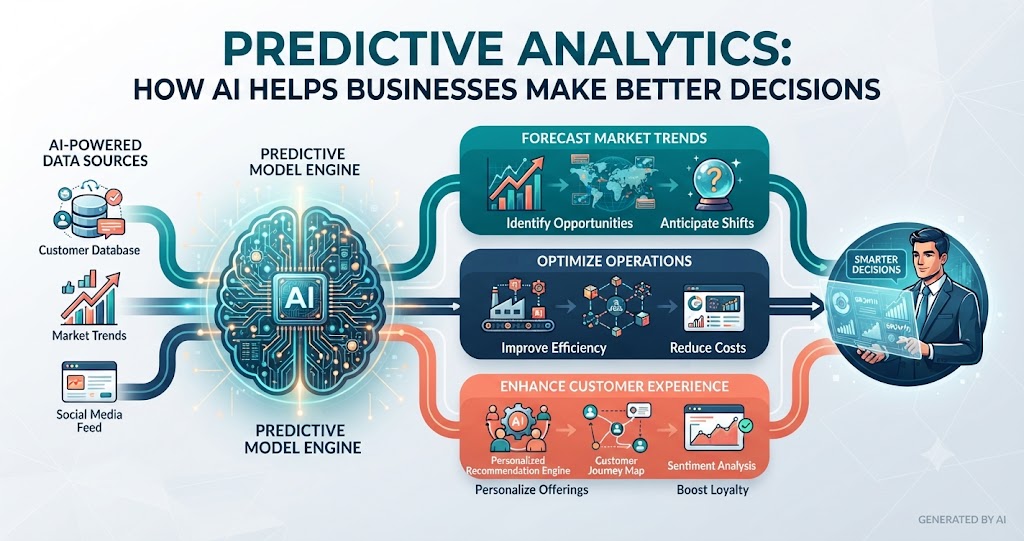
Predictive Analytics combines Artificial Intelligence (AI), Machine Learning (ML), and statistical analysis to forecast future outcomes based on historical and real-time data. Instead of reacting to problems after they occur, businesses can anticipate trends, identify opportunities, reduce risks, and make smarter decisions before challenges arise.
From retail and healthcare to finance, manufacturing, logistics, and marketing, predictive analytics has become one of the most valuable technologies driving business growth in 2026.
What is Predictive Analytics?
Predictive Analytics is the process of analyzing historical data, identifying patterns, and using AI-powered algorithms to estimate future events or behaviors. It helps businesses answer questions such as:
- Which customers are most likely to make a purchase?
- Which products will be in highest demand next month?
- Which machines may require maintenance soon?
- Which marketing campaign is likely to generate the highest return?
- Which customers are at risk of leaving?
Rather than relying on assumptions, organizations use predictive models to make decisions based on accurate data and intelligent forecasts.
How AI Powers Predictive Analytics
Traditional forecasting methods often depended on manual calculations and static reports. Artificial Intelligence has significantly improved predictive analytics by processing massive datasets much faster and identifying complex relationships that humans might overlook.
AI continuously learns from new information, allowing predictive models to become more accurate over time. As businesses generate additional data, machine learning algorithms refine their predictions, enabling organizations to make increasingly informed decisions.
This ability to learn and adapt makes AI-powered predictive analytics far more effective than traditional forecasting methods.
Why Predictive Analytics Matters for Businesses
In today's competitive business environment, making decisions based solely on historical reports is no longer enough. Markets change rapidly, customer preferences evolve, and operational risks can emerge unexpectedly.
Predictive analytics enables organizations to:
- Anticipate customer behavior
- Reduce business risks
- Improve operational efficiency
- Increase revenue opportunities
- Optimize inventory management
- Enhance customer satisfaction
- Strengthen strategic planning
- Support faster decision-making
Businesses that predict future trends can respond proactively instead of reacting after opportunities have passed.
Key Business Applications of Predictive Analytics
Predictive analytics supports nearly every department within an organization.
Sales Forecasting
AI analyzes historical sales data, seasonal demand, market conditions, and customer purchasing patterns to estimate future sales performance. Accurate forecasting helps businesses allocate resources more effectively and improve financial planning.
Customer Behavior Analysis
Predictive models identify customer preferences, buying habits, browsing patterns, and engagement history. Businesses can personalize offers, recommend products, and improve customer experiences based on these insights.
Marketing Optimization
Marketing teams use predictive analytics to identify high-value audiences, improve campaign targeting, estimate conversion rates, and maximize return on advertising investments.
Inventory Management
Retailers and manufacturers forecast product demand to avoid stock shortages or excess inventory. Better inventory planning reduces storage costs and improves customer satisfaction.
Financial Risk Assessment
Banks, insurance companies, and financial institutions use predictive models to detect fraud, evaluate credit risk, and identify suspicious transactions before they become major issues.
Predictive Maintenance
Manufacturing companies monitor equipment performance using sensors and AI models to predict maintenance requirements before machinery fails, reducing downtime and repair costs.
Healthcare Decision Support
Healthcare providers analyze patient records, medical histories, and diagnostic information to identify potential health risks and support earlier interventions.
Benefits of Predictive Analytics
Organizations implementing predictive analytics gain significant business advantages.
Smarter Decision-Making
Business leaders receive reliable forecasts that support strategic planning and reduce uncertainty.
Increased Efficiency
AI automates data analysis, allowing employees to spend more time focusing on business growth instead of manually reviewing reports.
Improved Customer Experiences
Businesses understand customer needs more accurately and deliver personalized products, services, and communication.
Cost Reduction
Predictive maintenance, inventory optimization, and resource planning help reduce operational expenses while improving productivity.
Better Risk Management
Organizations identify potential problems earlier, allowing preventive actions that minimize financial losses and operational disruptions.
Competitive Advantage
Companies that leverage predictive insights often respond faster to market changes than competitors relying solely on historical reporting.
Industries Benefiting from Predictive Analytics
Predictive analytics is transforming businesses across many industries.
Common sectors include:
- Retail and eCommerce
- Healthcare
- Banking and Financial Services
- Manufacturing
- Logistics and Supply Chain
- Education
- Telecommunications
- Insurance
- Real Estate
- Hospitality
- Government
- Software Development
Every industry that generates data can benefit from predictive insights.
Challenges in Predictive Analytics
Although predictive analytics provides remarkable opportunities, successful implementation requires careful planning.
Some common challenges include:
- Poor data quality
- Incomplete datasets
- Data privacy concerns
- Integration with existing systems
- Model accuracy
- Regulatory compliance
- Skilled AI professionals
- Ongoing model maintenance
Organizations that invest in clean data and reliable AI solutions achieve the most accurate predictions.
Emerging Predictive Analytics Trends in 2026
The future of predictive analytics continues to evolve as AI technologies become more advanced.
Key trends include:
- Generative AI-powered forecasting
- Real-time predictive dashboards
- Explainable AI models
- Edge AI analytics
- Automated machine learning
- AI-driven business intelligence
- Hyper-personalized customer experiences
- Cloud-native predictive platforms
- Predictive cybersecurity
- Sustainability forecasting
These innovations are helping businesses make decisions with greater speed, accuracy, and confidence.
How Coding Rig Develops AI-Powered Predictive Analytics Solutions
At Coding Rig, we build intelligent predictive analytics solutions that help organizations transform business data into actionable insights. Our services include AI model development, machine learning implementation, predictive dashboards, business intelligence integration, data visualization, cloud analytics, and custom forecasting systems.
We integrate predictive analytics with ERP, CRM, HRMS, inventory management, healthcare platforms, financial systems, and enterprise applications to help businesses automate decision-making and improve operational performance.
Our goal is to provide scalable, secure, and data-driven solutions that enable organizations to stay ahead of market trends and unlock new growth opportunities.
Conclusion
Predictive analytics has become one of the most valuable applications of Artificial Intelligence in modern business. By analyzing historical and real-time data, AI helps organizations forecast future outcomes, improve operational efficiency, reduce risks, and deliver better customer experiences.
As businesses continue embracing digital transformation in 2026, predictive analytics will play an increasingly important role in strategic planning and competitive advantage. Companies that leverage AI-driven insights today will be better prepared to respond to tomorrow's challenges and opportunities.
Rather than simply understanding what happened in the past, predictive analytics empowers businesses to anticipate what comes next—making every decision smarter, faster, and more confident.