API Integration Explained: How It Connects Your Business Systems
In today's fast-paced digital world, businesses use multiple software applications to manage their daily operations. Customer information may be stored in a CRM, invoices generated through accounting software, inventory tracked in an ERP system, payments processed by an online gateway, and marketing campaigns managed through separate automation platforms. While each application serves a specific purpose, managing them independently often results in duplicated work, inconsistent data, and inefficient processes.
This is where API Integration becomes a game-changer. APIs enable different software systems to communicate with one another, allowing businesses to automate workflows, synchronize data, and improve operational efficiency without manual intervention.
Whether you're running an eCommerce store, healthcare platform, logistics company, educational institution, or enterprise organization, API integration plays a critical role in building a connected digital ecosystem.
What is API Integration?
API stands for Application Programming Interface. An API is a set of rules that allows two or more software applications to exchange information securely and efficiently.
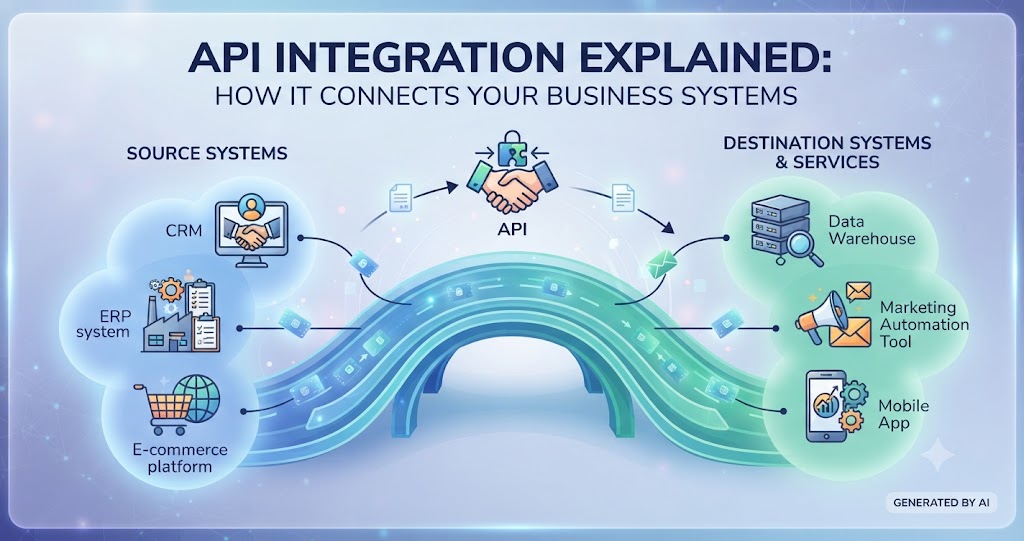
API integration is the process of connecting different software systems so they can automatically share data and perform tasks together. Instead of manually entering the same information into multiple platforms, APIs transfer data instantly between connected applications.
For example, when a customer places an order on your website, an API can automatically update your inventory system, generate an invoice, notify the shipping provider, and send an order confirmation email—all without human intervention.
Why API Integration Matters
Modern businesses depend on multiple digital tools. Without integration, teams often spend valuable time copying information between systems, increasing the risk of errors and delays.
API integration eliminates these challenges by creating seamless communication between applications. It improves productivity, reduces operational costs, enhances customer experiences, and ensures data remains consistent across departments.
As businesses continue adopting cloud-based software in 2026, API integration has become essential for digital transformation and scalable business operations.
How API Integration Works
API integration follows a simple communication process.
One application sends a request to another application's API. The receiving system processes the request, retrieves or updates the required information, and sends a response back to the requesting application.
This communication happens within seconds, allowing multiple systems to work together in real time.
For instance, when a customer updates their address in a CRM, an integrated API can instantly synchronize the updated information with billing software, delivery systems, customer support platforms, and marketing tools.
Common Types of API Integrations
Businesses use APIs across various functions to improve efficiency.
Payment Gateway Integration
Payment APIs securely process online transactions, verify payments, and update order statuses automatically.
CRM Integration
Customer Relationship Management systems integrate with websites, sales platforms, marketing tools, and customer support software to maintain centralized customer records.
ERP Integration
Enterprise Resource Planning systems connect finance, inventory, procurement, production, and human resources into one streamlined workflow.
Email and Marketing Integration
Marketing platforms automatically receive customer data, trigger personalized campaigns, send newsletters, and monitor engagement.
Accounting Integration
Accounting APIs synchronize invoices, expenses, tax information, customer payments, and financial reports with business operations.
Cloud Storage Integration
Businesses connect applications with cloud storage services to automatically upload, organize, and retrieve files.
Logistics and Shipping Integration
Shipping APIs calculate delivery costs, generate shipping labels, track orders, and provide real-time delivery updates.
Benefits of API Integration
Businesses implementing API integration experience improvements across multiple areas.
Increased Productivity
Automation reduces repetitive manual tasks, allowing employees to focus on strategic business activities instead of data entry.
Real-Time Data Synchronization
Information updates automatically across connected systems, ensuring every department works with accurate and current data.
Reduced Human Errors
Automatic data transfer minimizes mistakes caused by manual entry, improving data accuracy and consistency.
Better Customer Experience
Integrated systems enable faster order processing, personalized communication, real-time updates, and quicker customer support.
Improved Scalability
As businesses grow, new software solutions can be integrated without rebuilding existing infrastructure.
Lower Operational Costs
Automation reduces labor costs, minimizes administrative work, and improves overall business efficiency.
Industries That Benefit from API Integration
API integration supports organizations across nearly every industry.
Popular use cases include:
- E-commerce businesses
- Healthcare organizations
- Educational institutions
- Financial services
- Manufacturing companies
- Logistics providers
- Travel agencies
- Real estate businesses
- Human resource management
- Government organizations
- Retail stores
- SaaS companies
Regardless of industry, API integration helps businesses simplify operations and improve collaboration between systems.
Popular Business Systems Connected Through APIs
Many organizations integrate multiple software platforms to create a unified digital environment.
Common integrations include:
- Website with CRM
- CRM with ERP
- ERP with Accounting Software
- Inventory Management with eCommerce Platforms
- Payment Gateway with Online Store
- HRMS with Payroll Software
- Customer Support with CRM
- Marketing Automation with Lead Forms
- Warehouse Management with Logistics Providers
- Mobile Apps with Cloud Databases
These integrations eliminate isolated data silos and improve overall business visibility.
API Security Best Practices
Since APIs exchange sensitive business information, security is a top priority.
Businesses should implement:
- Secure authentication methods
- API keys and access tokens
- HTTPS encryption
- Role-based access control
- Rate limiting
- Input validation
- Regular security monitoring
- API version management
- Activity logging
- Data encryption
Following these practices helps protect customer information and maintain secure communication between applications.
Challenges of API Integration
Although API integration provides significant benefits, businesses may encounter certain challenges.
These include:
- Compatibility between legacy systems
- Data format differences
- Authentication complexities
- Third-party API limitations
- Performance optimization
- Security compliance
- Version updates
- Documentation quality
Working with experienced developers helps overcome these challenges while ensuring reliable integration.
API Integration Trends in 2026
Technology continues to reshape how businesses connect applications.
Some emerging trends include:
- AI-powered API automation
- Low-code integration platforms
- Event-driven APIs
- Serverless API architectures
- GraphQL adoption
- API-first software development
- Cloud-native integrations
- Real-time analytics APIs
- IoT device connectivity
- Enhanced API security frameworks
These innovations make integrations faster, smarter, and easier to manage.
How Coding Rig Delivers Seamless API Integration
At Coding Rig, we develop secure and scalable API integration solutions that connect websites, mobile applications, ERP systems, CRM platforms, payment gateways, accounting software, inventory management systems, cloud services, and third-party business applications.
Our development team focuses on reliable architecture, secure authentication, high-performance data exchange, and future-ready integrations that improve operational efficiency and business productivity.
Whether you need custom API development or third-party system integration, we build solutions that automate workflows and help your business operate as one connected ecosystem.
Conclusion
API integration is no longer a technical luxury—it has become a necessity for businesses that want to improve efficiency, reduce manual work, and deliver better customer experiences. By enabling different software systems to communicate seamlessly, APIs create faster workflows, accurate data synchronization, and smarter business operations.
As organizations continue embracing digital transformation in 2026, connected systems will become the foundation of successful businesses. Investing in robust API integration today allows companies to streamline operations, scale with confidence, and stay competitive in an increasingly connected world.
Businesses that prioritize integration don't just save time—they build a smarter, more agile foundation for long-term growth.