Business Intelligence (BI): How Data Helps Businesses Make Smarter Decisions (2026 Guide)
In today's digital economy, businesses generate more data than ever before. Every customer interaction, online purchase, website visit, marketing campaign, and financial transaction creates valuable information. However, data alone has little value unless it can be analyzed and transformed into actionable insights. This is where Business Intelligence (BI) becomes essential.
Business Intelligence helps organizations collect, organize, analyze, and visualize data to make informed decisions. Instead of relying on assumptions or outdated reports, companies can use real-time insights to improve operations, identify new opportunities, and respond quickly to changing market conditions.
Whether you're running a startup, an eCommerce business, a manufacturing company, or a large enterprise, Business Intelligence enables smarter planning and stronger business performance.
What is Business Intelligence (BI)?
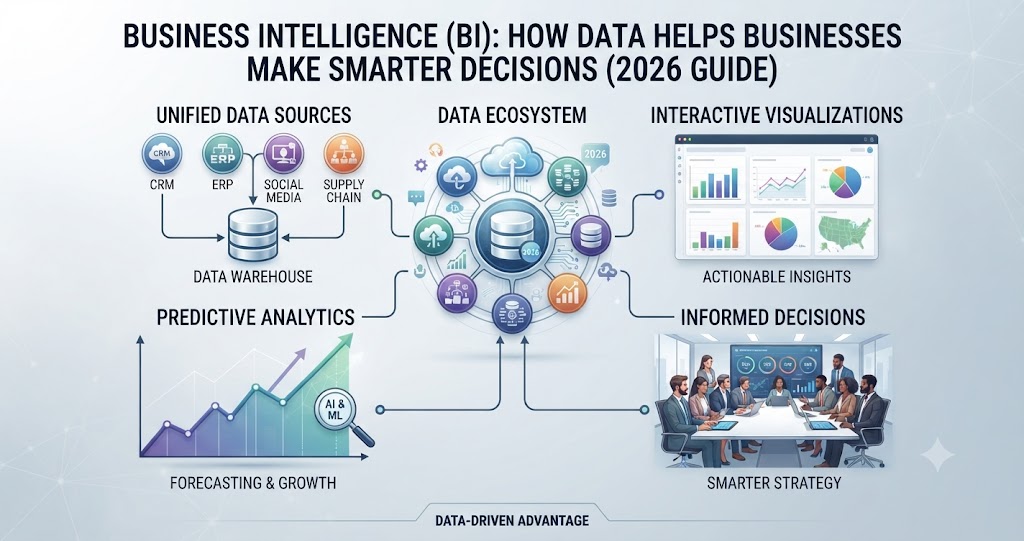
Business Intelligence (BI) is a combination of technologies, software, processes, and strategies that convert business data into meaningful reports, dashboards, and visualizations. The goal is to help decision-makers understand what is happening within the organization and take actions based on accurate information.
A BI system gathers data from multiple sources such as CRM software, ERP systems, accounting platforms, websites, mobile applications, and cloud databases. It then processes the information into easy-to-read charts, reports, and dashboards.
Instead of manually reviewing spreadsheets, business leaders gain instant access to performance metrics that support faster and more confident decision-making.
Why Business Intelligence Matters in 2026
As businesses continue adopting digital technologies, the amount of available data continues to grow rapidly. Companies that can effectively analyze this information gain a competitive advantage.
Business Intelligence helps organizations:
- Make faster business decisions
- Identify market trends
- Improve customer satisfaction
- Increase operational efficiency
- Reduce unnecessary expenses
- Monitor business performance in real time
- Forecast future growth
- Improve profitability
Organizations that rely on data rather than guesswork are often better equipped to adapt to changing customer needs and market conditions.
Key Components of Business Intelligence
A modern BI solution combines several essential components to deliver meaningful insights.
Data Collection
Business data is collected from various sources, including sales software, customer databases, marketing platforms, inventory systems, finance applications, and website analytics.
Data Integration
Collected data is cleaned, organized, and merged into a centralized system, ensuring consistency and accuracy across departments.
Data Analysis
Advanced analytics identify patterns, trends, and relationships within the data, helping businesses understand what is driving performance.
Reporting and Dashboards
Interactive dashboards present key metrics through charts, graphs, and visual reports, making complex information easy to interpret.
Performance Monitoring
Businesses can track important Key Performance Indicators (KPIs) continuously and respond quickly when results change.
How Business Intelligence Helps Different Departments
Business Intelligence supports decision-making across every area of an organization.
Sales Teams
Sales managers can monitor revenue, conversion rates, sales pipelines, and regional performance to identify opportunities for growth.
Marketing Teams
Marketing professionals analyze campaign performance, customer engagement, lead generation, and return on investment to optimize advertising strategies.
Finance Departments
Financial dashboards simplify budgeting, expense tracking, cash flow monitoring, forecasting, and profitability analysis.
Human Resources
HR teams can monitor employee performance, recruitment trends, training progress, attendance, and workforce productivity.
Operations and Manufacturing
Operations managers use BI to monitor production efficiency, inventory levels, supply chain performance, equipment utilization, and quality control.
Major Benefits of Business Intelligence
Organizations implementing Business Intelligence experience improvements across multiple business functions.
Some of the biggest advantages include:
- Faster decision-making
- Better business forecasting
- Increased productivity
- Improved customer experiences
- Reduced operational costs
- Real-time reporting
- Enhanced data accuracy
- Better collaboration between departments
- Increased revenue opportunities
- Improved strategic planning
By making information accessible across teams, BI creates a more data-driven culture within the organization.
Business Intelligence vs Traditional Reporting
Traditional reporting often relies on static spreadsheets that quickly become outdated. Business Intelligence, on the other hand, provides dynamic dashboards that update automatically as new data becomes available.
This allows business leaders to monitor performance in real time instead of waiting for monthly reports. Interactive dashboards also enable users to drill down into specific metrics, making it easier to identify opportunities and solve problems.
Emerging Business Intelligence Trends in 2026
Business Intelligence continues to evolve alongside advances in Artificial Intelligence, automation, and cloud computing.
Some of the most important trends include:
- AI-powered predictive analytics
- Natural language queries for reports
- Real-time cloud dashboards
- Self-service Business Intelligence
- Mobile BI applications
- Automated data visualization
- Machine learning insights
- Embedded analytics within business software
These innovations help businesses analyze larger volumes of data while reducing manual effort.
How Coding Rig Builds Business Intelligence Solutions
At Coding Rig, we develop customized Business Intelligence solutions that transform business data into actionable insights. Our BI services include dashboard development, real-time reporting, KPI monitoring, cloud-based analytics, database integration, and custom reporting systems tailored to each organization's requirements.
We integrate BI platforms with ERP, CRM, HRMS, accounting software, inventory management systems, and other business applications, enabling organizations to monitor operations from a single centralized dashboard.
Our solutions are designed to improve decision-making, increase efficiency, and support sustainable business growth.
Conclusion
Business Intelligence has become an essential tool for organizations seeking to make smarter, faster, and more informed decisions. By turning raw business data into meaningful insights, BI helps companies optimize operations, improve customer experiences, reduce costs, and identify new growth opportunities.
As businesses continue embracing digital transformation in 2026, investing in Business Intelligence is no longer optional—it is a strategic necessity. Organizations that use data effectively will be better positioned to innovate, compete, and grow in an increasingly data-driven marketplace.
Whether you operate a small business or a large enterprise, implementing the right Business Intelligence solution can unlock valuable insights that lead to long-term success.