AI in Software Development: Benefits, Tools, and Future Trends (2026 Guide)
Artificial Intelligence (AI) has rapidly become one of the most influential technologies in the software industry. What once required weeks of manual coding, testing, and debugging can now be completed much faster with the assistance of AI-powered development tools. Rather than replacing software developers, AI is helping them become more productive by automating repetitive tasks, improving code quality, and accelerating the entire software development lifecycle.
Today, startups, enterprises, and software development companies are integrating AI into their workflows to reduce development time, enhance application performance, and deliver innovative digital products. From intelligent code generation and automated testing to predictive analytics and cybersecurity, AI is reshaping how software is designed, developed, and maintained.
As businesses continue investing in digital transformation, understanding the role of AI in software development has become essential. This guide explores how AI is changing software engineering, its key benefits, practical applications, emerging trends, and why it is becoming a competitive advantage in 2026.
What is AI in Software Development?
AI in software development refers to the use of Artificial Intelligence, Machine Learning (ML), and intelligent automation to support developers throughout the software development process. AI systems analyze data, recognize coding patterns, learn from previous projects, and provide intelligent recommendations that improve development efficiency.
Unlike traditional development tools that rely entirely on manual programming, AI-powered solutions assist with writing code, detecting bugs, generating documentation, optimizing performance, and even predicting potential issues before they affect users.
The goal is not to replace human creativity but to allow developers to focus on solving complex business problems while AI handles repetitive and time-consuming tasks.
Why AI is Transforming Software Development
Modern software projects are becoming increasingly complex. Applications must support multiple devices, integrate with cloud platforms, process large datasets, and maintain high security standards while being delivered faster than ever before.
AI helps organizations meet these challenges by automating routine development activities and providing valuable insights throughout the project lifecycle.
Businesses adopting AI in software development benefit from:
- Faster product delivery
- Higher development efficiency
- Improved software quality
- Reduced operational costs
- Better collaboration between development teams
- Enhanced customer experiences
- Smarter project planning
AI enables development teams to work more efficiently without compromising quality.
Key Applications of AI in Software Development
Artificial Intelligence is being integrated into nearly every stage of software development.
Intelligent Code Generation
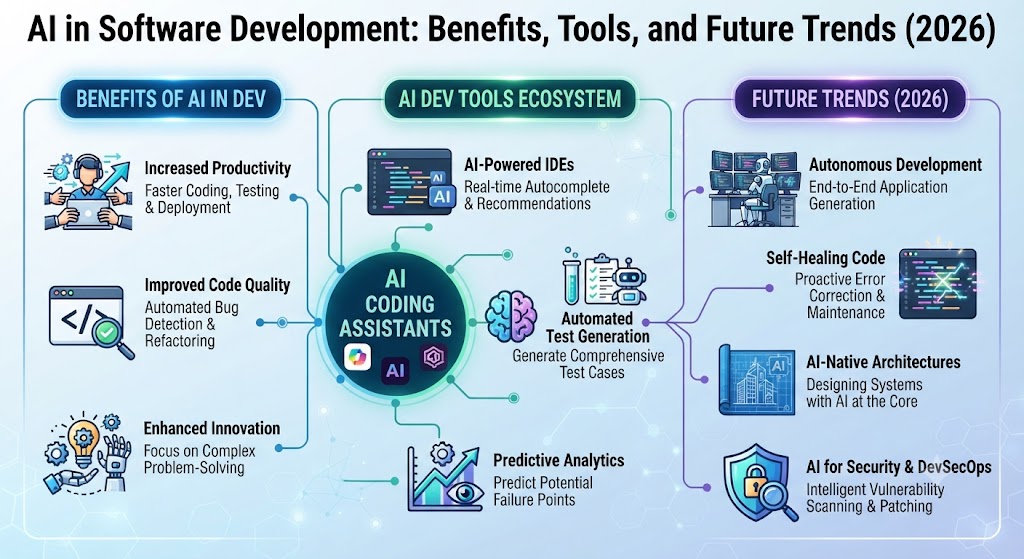
AI-powered coding assistants help developers write code faster by suggesting functions, completing repetitive code blocks, identifying syntax errors, and recommending best coding practices.
This reduces development time while improving code consistency.
Automated Testing
Testing is one of the most time-consuming phases of software development. AI automates test case generation, regression testing, UI testing, performance analysis, and bug detection, allowing teams to release software more confidently.
Bug Detection and Debugging
AI analyzes application behavior and source code to identify vulnerabilities, performance bottlenecks, and logical errors before deployment.
Early bug detection reduces maintenance costs and improves software reliability.
Code Review and Optimization
AI tools review code quality, identify inefficient logic, recommend improvements, and ensure coding standards are consistently followed across projects.
Predictive Project Management
AI analyzes project timelines, team productivity, resource allocation, and development history to estimate project completion dates and identify potential risks.
Project managers can make better decisions based on real-time insights.
AI-Powered Chatbots and Virtual Assistants
Developers increasingly integrate AI chatbots into applications to automate customer support, answer frequently asked questions, and provide personalized assistance.
Benefits of AI in Software Development
Implementing AI throughout the software development lifecycle offers numerous advantages.
Faster Development
AI automates repetitive coding tasks, allowing developers to build applications more quickly while maintaining high quality.
Improved Code Quality
AI-powered recommendations help reduce coding mistakes, improve readability, and encourage best development practices.
Reduced Development Costs
Automation minimizes manual effort, reducing project costs while increasing productivity.
Better Software Security
AI identifies vulnerabilities, suspicious activities, and potential cyber threats earlier, strengthening application security.
Increased Developer Productivity
Developers spend less time on repetitive work and more time designing innovative features and solving business challenges.
Better User Experience
AI supports personalization, intelligent recommendations, predictive search, and automated customer interactions, improving overall application usability.
AI Across the Software Development Lifecycle
Artificial Intelligence contributes to every phase of software development.
Planning
AI analyzes business requirements, estimates project timelines, and predicts resource requirements.
Design
Design tools use AI to generate interface suggestions, improve accessibility, and optimize user experiences.
Development
Developers receive intelligent coding assistance, automated documentation, and real-time code suggestions.
Testing
AI automates functional testing, regression testing, performance testing, and defect detection.
Deployment
AI monitors deployments, identifies performance issues, and recommends optimization strategies.
Maintenance
Machine learning continuously analyzes application performance, predicts failures, and recommends improvements after deployment.
Industries Using AI-Powered Software Development
Organizations across multiple industries are integrating AI into their software projects.
Common sectors include:
- Healthcare
- Banking and Financial Services
- Retail and eCommerce
- Education
- Manufacturing
- Logistics
- Insurance
- Real Estate
- Telecommunications
- Government
- Travel and Hospitality
- SaaS Companies
Every industry developing digital solutions can benefit from AI-assisted software engineering.
Challenges of AI in Software Development
Despite its advantages, AI adoption also presents several challenges.
Businesses should consider:
- Data privacy and security
- Model accuracy
- Integration complexity
- Ethical AI usage
- Initial implementation costs
- Dependence on high-quality data
- Continuous model training
- Developer upskilling
Successful implementation requires balancing AI automation with human expertise and oversight.
Future Trends of AI in Software Development
Artificial Intelligence continues evolving rapidly, introducing new opportunities for software engineering.
Key trends expected to shape 2026 include:
- Autonomous software testing
- AI-powered DevOps automation
- Generative AI application development
- Low-code and no-code AI platforms
- Intelligent cybersecurity systems
- AI-driven user experience personalization
- Predictive software maintenance
- Natural language programming
- AI-assisted cloud infrastructure management
- Self-optimizing software applications
These advancements will enable developers to build smarter applications faster than ever before.
Best Practices for Implementing AI in Software Development
Organizations adopting AI should follow a structured implementation strategy.
Recommended practices include:
- Identify suitable automation opportunities
- Maintain high-quality datasets
- Integrate AI gradually into development workflows
- Monitor AI-generated outputs carefully
- Prioritize security and compliance
- Continuously train development teams
- Measure performance improvements
- Combine AI efficiency with human expertise
A balanced approach ensures organizations maximize AI benefits while maintaining software quality.
How Coding Rig Leverages AI for Modern Software Development
At Coding Rig, we combine Artificial Intelligence with modern software engineering practices to build intelligent, scalable, and future-ready digital solutions. Our development process incorporates AI-powered automation, smart testing, performance optimization, cloud integration, predictive analytics, and secure application development.
Whether developing enterprise software, SaaS platforms, ERP systems, mobile applications, healthcare solutions, or custom business software, we use AI to accelerate development, improve software quality, and deliver exceptional user experiences.
Our focus is to help businesses embrace innovation while creating software that is efficient, secure, and built for long-term growth.
Conclusion
Artificial Intelligence is revolutionizing software development by making coding faster, testing smarter, security stronger, and applications more intelligent. Rather than replacing developers, AI acts as a powerful assistant that enhances productivity, reduces repetitive work, and supports better decision-making throughout the development lifecycle.
As AI technologies continue advancing in 2026, businesses that integrate intelligent development practices will gain a significant competitive advantage. Faster product releases, improved software quality, enhanced customer experiences, and greater operational efficiency are just a few of the benefits AI brings to modern software engineering.
For organizations looking to innovate and scale, adopting AI in software development is no longer an option—it is a strategic investment that will shape the future of digital transformation.