Digital Marketing Trends 2026: The Strategies Every Business Needs to Stay Ahead
Digital marketing has never evolved as quickly as it is today. Consumer behavior is changing, search engines are becoming more intelligent, social media platforms are introducing new shopping experiences, and Artificial Intelligence is transforming how businesses connect with customers. Strategies that worked a few years ago are no longer enough to maintain visibility in an increasingly competitive online marketplace.
In 2026, successful digital marketing is no longer about reaching the largest audience—it’s about reaching the right audience with the right message at the right time. Businesses that embrace modern technologies, data-driven decision-making, and personalized customer experiences are building stronger brands and achieving higher returns on their marketing investments.
Whether you're a startup, an established business, or an eCommerce brand, understanding the latest digital marketing trends can help you stay ahead of competitors and build meaningful relationships with your customers.
This guide explores the most important digital marketing trends shaping 2026 and how businesses can use them to achieve long-term success.
Why Digital Marketing Continues to Evolve
Technology continues to reshape how people search, shop, communicate, and make purchasing decisions. Customers now interact with brands across multiple channels, including websites, search engines, social media, mobile apps, messaging platforms, and voice assistants.
Businesses must adapt by creating connected digital experiences that deliver value across every touchpoint.
Modern digital marketing focuses on:
- Personalized customer experiences
- Data-driven decision-making
- Omnichannel communication
- Automation and efficiency
- High-quality content
- Long-term customer relationships
Companies that continuously adapt to these changes remain competitive in a fast-moving digital landscape.
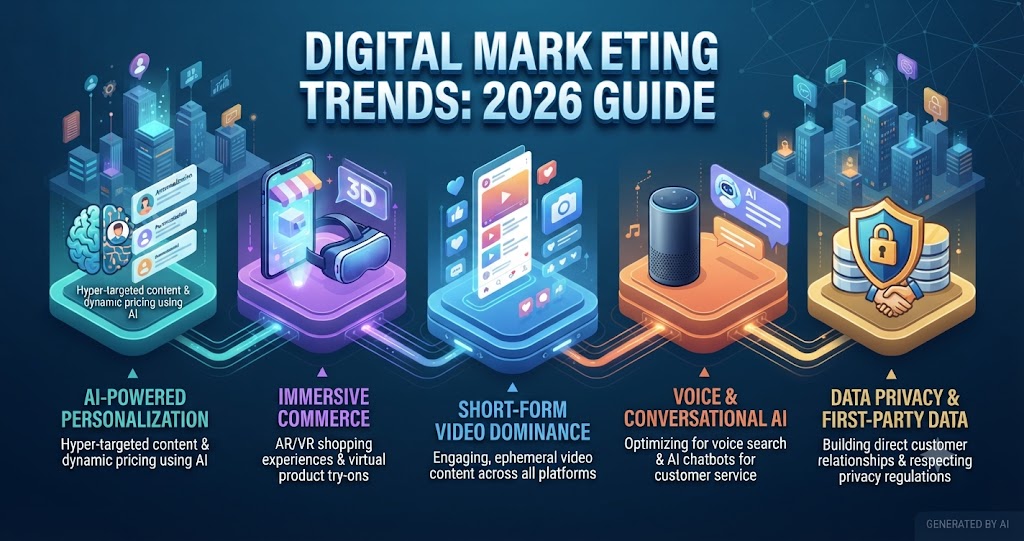
AI-Powered Marketing Becomes the New Standard
Artificial Intelligence is now at the center of modern marketing strategies. AI helps businesses analyze customer behavior, automate repetitive tasks, and deliver highly personalized experiences.
AI supports marketers by:
- Predicting customer preferences
- Generating content ideas
- Automating email campaigns
- Improving customer segmentation
- Optimizing advertising performance
- Enhancing chatbot conversations
- Delivering personalized recommendations
Rather than replacing marketers, AI allows teams to work faster while making smarter decisions based on real-time data.
Search Is Becoming More Conversational
People no longer search using short keywords alone. Instead, they ask complete questions through search engines, voice assistants, and AI-powered search platforms.
Businesses should create content that answers real customer questions naturally.
Instead of focusing only on traditional SEO, marketers should optimize for:
- Conversational search
- Long-tail keywords
- Question-based content
- Featured snippets
- AI-generated search results
- Answer Engine Optimization (AEO)
Providing direct, valuable answers increases visibility across modern search experiences.
Video Content Continues to Dominate
Video remains one of the most engaging content formats across digital platforms.
Consumers increasingly prefer short, informative videos that explain products, demonstrate services, or share educational content.
Popular video formats include:
- Product demonstrations
- Behind-the-scenes content
- Customer testimonials
- Educational tutorials
- Live streaming
- Industry updates
- Company culture videos
Businesses that consistently publish high-quality video content often experience higher engagement and stronger brand recognition.
Personalization Is Driving Better Customer Experiences
Modern customers expect brands to understand their interests and deliver relevant experiences.
Personalized marketing includes:
- Customized product recommendations
- Personalized email campaigns
- Dynamic website content
- Location-based offers
- Behavioral targeting
- Individual customer journeys
Personalization improves customer satisfaction while increasing conversion rates and long-term loyalty.
Social Commerce Continues to Grow
Social media platforms have become complete shopping destinations rather than simply communication channels.
Customers now discover products, read reviews, watch demonstrations, and complete purchases without leaving their favorite social platforms.
Businesses should focus on:
- Interactive product posts
- Influencer partnerships
- Live shopping events
- User-generated content
- Community engagement
- Fast customer responses
Social commerce shortens the buying journey and improves customer convenience.
First-Party Data Is More Valuable Than Ever
As privacy regulations continue evolving, businesses rely increasingly on first-party data collected directly from their customers.
This includes:
- Website registrations
- Newsletter subscriptions
- Purchase history
- Customer preferences
- Loyalty programs
- Feedback surveys
Using first-party data responsibly helps businesses create personalized marketing campaigns while maintaining customer trust.
Omnichannel Marketing Creates Consistent Experiences
Customers interact with brands across multiple platforms before making purchasing decisions.
An effective omnichannel strategy ensures consistency across:
- Business websites
- Mobile applications
- Social media
- Email marketing
- Search advertising
- SMS campaigns
- Customer support
- Online marketplaces
Providing a seamless experience across channels strengthens customer relationships and increases brand credibility.
Data Analytics Drives Smarter Marketing Decisions
Successful marketers no longer rely on assumptions. Instead, they use analytics to understand customer behavior and optimize campaign performance.
Key performance metrics include:
- Website traffic
- Conversion rates
- Customer acquisition cost
- Return on advertising spend
- Email engagement
- Customer lifetime value
- Bounce rates
- Organic search performance
Continuous analysis allows businesses to improve marketing strategies based on measurable results.
SEO and Content Marketing Remain Essential
While digital marketing technologies continue evolving, high-quality content remains one of the strongest drivers of long-term online visibility.
Businesses should focus on creating content that:
- Solves customer problems
- Answers common questions
- Demonstrates expertise
- Provides actionable insights
- Supports search intent
- Builds trust
Well-optimized content continues attracting organic traffic long after publication.
Emerging Digital Marketing Trends in 2026
Several innovations are shaping the future of digital marketing.
Key trends include:
- AI-generated content assistance
- Predictive marketing analytics
- Voice search optimization
- Interactive website experiences
- Augmented Reality product previews
- Zero-click search optimization
- Community-driven marketing
- Sustainable brand storytelling
- Privacy-first advertising
- AI-powered customer service
Businesses adopting these technologies early gain stronger competitive advantages.
Best Practices for Digital Marketing Success
To achieve consistent results, businesses should focus on long-term strategies rather than short-term tactics.
Recommended practices include:
- Understand your target audience
- Create valuable content consistently
- Optimize websites for speed and mobile devices
- Invest in SEO and AEO
- Use AI responsibly
- Measure campaign performance regularly
- Build trust through transparency
- Continuously test and improve marketing strategies
- Maintain consistent branding
- Prioritize customer experience
These practices help businesses build sustainable digital growth.
How Coding Rig Helps Businesses Grow Digitally
At Coding Rig, we provide comprehensive digital marketing solutions designed to increase online visibility, generate qualified leads, and strengthen brand authority. Our services include SEO, Answer Engine Optimization (AEO), social media marketing, PPC advertising, website development, content marketing, branding, email marketing, analytics, and performance optimization.
We combine creative strategies with data-driven insights to help businesses attract the right audience, improve customer engagement, and achieve measurable business growth.
Whether you're launching a new brand or scaling an established business, our team develops customized digital marketing strategies aligned with your goals.
Conclusion
Digital marketing in 2026 is defined by intelligence, personalization, and customer-focused experiences. Businesses that embrace AI, optimize for modern search behavior, create valuable content, and use data to guide their decisions will be better positioned to compete in an increasingly digital marketplace.
Success is no longer determined by how much content you publish or how many advertisements you run. Instead, it depends on how effectively you understand your audience, deliver meaningful experiences, and adapt to changing technologies.
By staying informed about emerging digital marketing trends and investing in innovative strategies, businesses can strengthen their online presence, build lasting customer relationships, and achieve sustainable growth in the years ahead.