Jamstack vs Traditional Websites: Which One Should You Choose?
Introduction
Choosing the right website architecture is one of the most important decisions for any business. Your website's performance, security, scalability, and maintenance costs all depend on the technology behind it.
Two of the most popular approaches today are Jamstack and Traditional Websites. While traditional websites have powered the internet for decades, Jamstack has emerged as a modern architecture focused on speed, security, and scalability.
In this guide, we'll compare Jamstack and traditional websites to help you determine which solution best fits your business goals.
What Is Jamstack?
Jamstack stands for:
- JavaScript
- APIs
- Markup
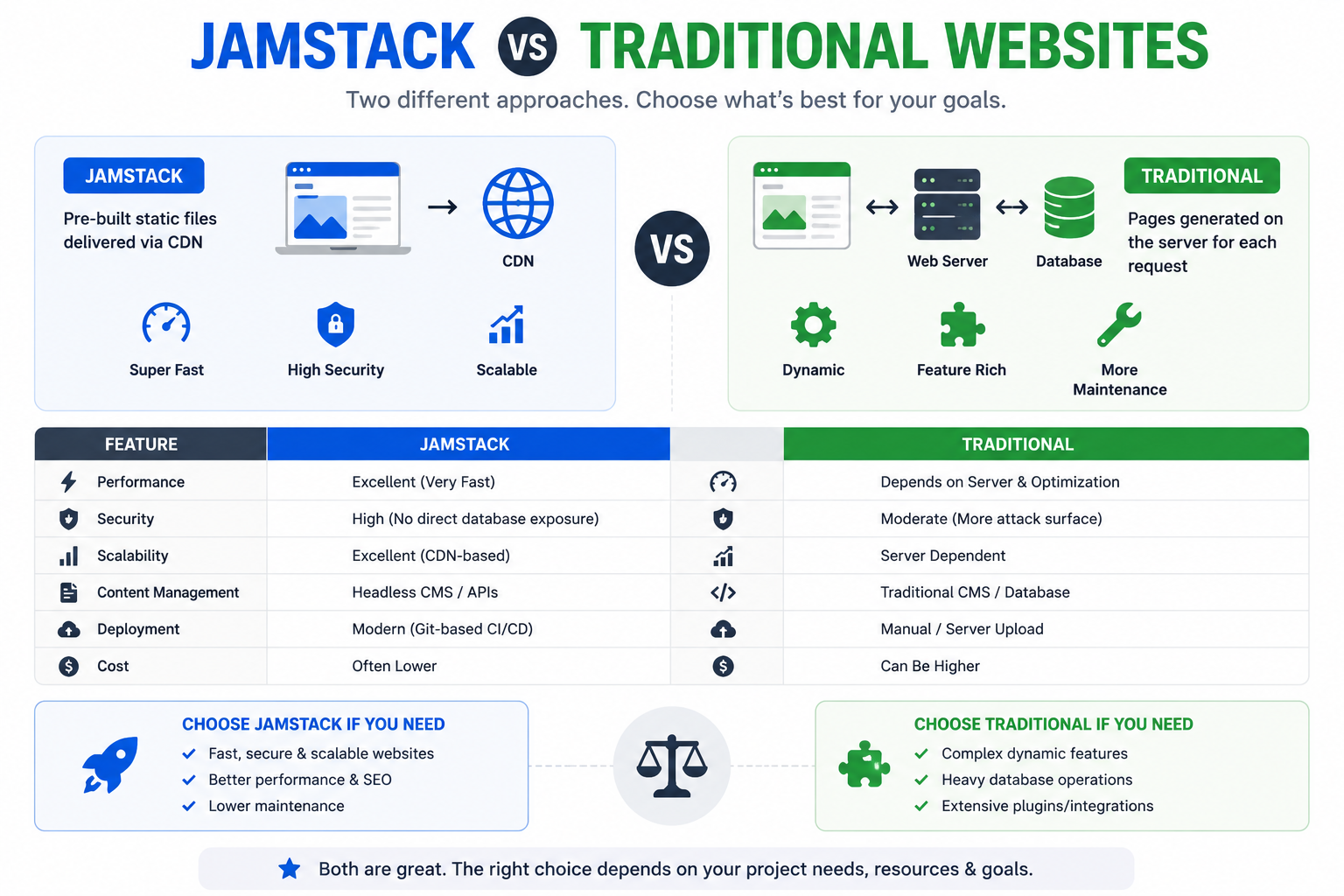
Instead of generating pages on the server every time a visitor requests them, Jamstack websites are pre-built into static files and delivered through a Content Delivery Network (CDN). Dynamic features such as forms, authentication, payments, and search are handled through APIs and serverless functions.
Popular Jamstack Technologies
- Next.js
- Gatsby
- Astro
- Nuxt
- Hugo
- Eleventy
What Is a Traditional Website?
Traditional websites generate pages dynamically on a web server whenever a visitor loads a page.
Popular traditional platforms include:
- WordPress
- Laravel
- PHP
- Django
- Ruby on Rails
- ASP.NET
These websites rely on a server, database, and backend application working together to deliver content.
Jamstack vs Traditional Websites: Key Differences
| Feature | Jamstack | Traditional Website |
|---|---|---|
| Speed | Extremely Fast | Depends on Server |
| Hosting | CDN-Based | Web Server |
| Security | High | Moderate |
| Scalability | Excellent | Server Dependent |
| Maintenance | Lower | Higher |
| Database | API-Based | Direct Database |
| Performance | Outstanding | Variable |
| Deployment | Modern CI/CD | Server Upload |
| SEO | Excellent | Good (if optimized) |
| Cost | Often Lower | Can Be Higher |
Performance Comparison
Jamstack
Jamstack websites serve pre-generated HTML directly from edge servers, resulting in:
- Faster loading times
- Lower latency
- Better Core Web Vitals
- Improved user experience
Traditional Websites
Traditional sites generate pages dynamically, which may involve:
- Database queries
- PHP execution
- Plugin processing
- Server-side rendering
Performance depends heavily on hosting quality and optimization.
SEO Benefits
Jamstack SEO Advantages
Jamstack websites typically achieve:
- Faster page speed
- Better Core Web Vitals
- Lower bounce rates
- Easier indexing
- Higher PageSpeed scores
These factors contribute to a stronger user experience and can support better search visibility.
Traditional Website SEO
Traditional websites can also perform well in search engines when properly optimized through:
- Image optimization
- Caching
- Quality hosting
- SEO plugins
- Clean code
SEO success depends more on implementation than the architecture alone.
Security Comparison
Jamstack
Jamstack reduces common security risks because:
- No direct database exposure
- Smaller attack surface
- Serverless architecture
- Static file delivery
- Fewer vulnerabilities
Traditional Websites
Traditional websites require ongoing security maintenance, including:
- Plugin updates
- CMS updates
- Firewall configuration
- Malware scanning
- Database protection
Without regular maintenance, they may be more vulnerable to attacks.
Development Experience
Jamstack
Developers benefit from:
- Modern frameworks
- Git-based workflows
- Easy deployment
- Component-based architecture
- API integrations
Traditional Websites
Traditional development offers:
- Mature ecosystems
- Extensive plugin libraries
- Familiar workflows
- Large developer communities
Cost Comparison
Jamstack Costs
Potential savings include:
- Affordable CDN hosting
- Lower bandwidth costs
- Reduced server maintenance
- Automatic scaling
- Minimal infrastructure management
Traditional Website Costs
Expenses may include:
- Managed hosting
- Database servers
- Security tools
- Plugin licenses
- Ongoing maintenance
When to Choose Jamstack
Jamstack is an excellent choice for:
- Business websites
- Landing pages
- Marketing websites
- Company portfolios
- SaaS websites
- Documentation sites
- Blogs
- High-performance web applications
When to Choose a Traditional Website
A traditional website may be more suitable if you need:
- Complex membership systems
- Large eCommerce platforms with advanced backend logic
- Heavy real-time database interactions
- Legacy integrations
- Highly customized server-side applications
Pros and Cons
Jamstack Pros
- Exceptional performance
- Excellent scalability
- Improved security
- Better Core Web Vitals
- Reduced maintenance
- CDN-powered delivery
- Modern development workflow
Jamstack Cons
- Learning curve for beginners
- Dynamic features often require APIs
- Build times can increase for very large sites
Traditional Website Pros
- Mature ecosystem
- Easy content management
- Rich plugin support
- Familiar architecture
- Flexible backend capabilities
Traditional Website Cons
- Slower performance without optimization
- Greater maintenance requirements
- Larger attack surface
- Higher server resource usage
Which One Is Better for SEO?
Neither architecture guarantees better rankings on its own. Search engines prioritize helpful, relevant content and a good user experience.
Jamstack can make it easier to achieve excellent performance metrics such as fast loading speeds and strong Core Web Vitals, while traditional websites can also rank exceptionally well when optimized correctly.
The best choice depends on your content, functionality, and business needs.
Frequently Asked Questions (FAQs)
Is Jamstack faster than traditional websites?
Yes. Because pages are pre-built and delivered through a CDN, Jamstack websites generally load faster than dynamically rendered websites.
Is Jamstack better for SEO?
Jamstack can provide SEO advantages through faster performance and improved Core Web Vitals, but high-quality content and proper technical SEO remain essential.
Can businesses use Jamstack?
Absolutely. Jamstack works well for corporate websites, SaaS platforms, marketing sites, blogs, portfolios, and documentation websites.
Is WordPress a traditional website?
Yes. WordPress is a traditional CMS that dynamically generates web pages, although it can also be used as a headless CMS in a Jamstack architecture.
Conclusion
Jamstack and traditional websites each have strengths. Jamstack excels in speed, security, scalability, and modern development workflows, making it a strong choice for performance-focused websites. Traditional websites remain a great option for projects that require complex backend functionality and extensive content management.
Before deciding, evaluate your business goals, expected traffic, budget, and feature requirements. Choosing the architecture that aligns with your needs will help create a website that is fast, secure, and ready to grow.