AWS vs Azure vs Google Cloud: Which Cloud Platform Is Best for Your Business? (2026 Guide)
Introduction
Cloud computing has become the backbone of modern digital businesses. Instead of investing in costly physical servers and maintaining complex IT infrastructure, organizations now use cloud platforms to build, deploy, and scale applications efficiently.
Among the leading providers, Amazon Web Services (AWS), Microsoft Azure, and Google Cloud Platform (GCP) dominate the market. While all three offer powerful cloud services, each has unique strengths suited to different business needs. Choosing the right platform depends on your existing infrastructure, budget, scalability requirements, and future goals.
This guide compares AWS, Azure, and Google Cloud to help you make the best decision for your business in 2026.
What Is Cloud Computing?
Cloud computing delivers computing resources such as servers, storage, databases, networking, AI services, and software over the internet. Instead of purchasing hardware, businesses pay only for the resources they use.
Key benefits include:
- Lower infrastructure costs
- High availability
- Automatic scalability
- Enhanced security
- Faster deployment
- Remote accessibility
- Disaster recovery
- Global performance
Cloud platforms help businesses innovate faster while reducing operational overhead.
Meet the Top Cloud Providers
Amazon Web Services (AWS)
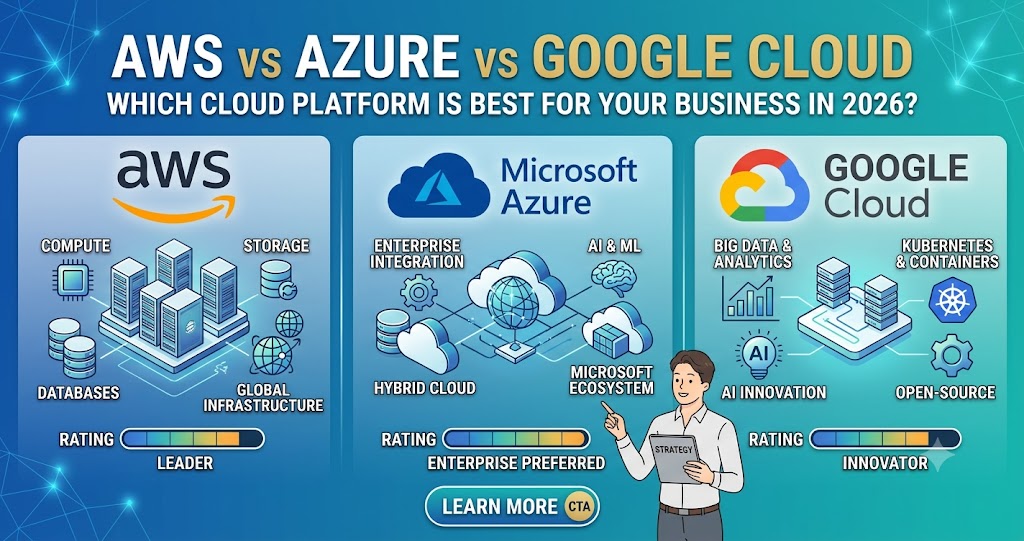
AWS is the largest cloud platform, trusted by startups, enterprises, and global organizations. It offers hundreds of cloud services that support everything from website hosting to AI and big data.
Ideal for:
- SaaS platforms
- Startups
- Enterprise applications
- eCommerce websites
- High-traffic web applications
Popular Services
- EC2
- S3
- RDS
- Lambda
- CloudFront
- SageMaker
Microsoft Azure
Azure is Microsoft's enterprise cloud platform and integrates seamlessly with Windows Server, Microsoft 365, Active Directory, and SQL Server.
Ideal for:
- Enterprise organizations
- Government sectors
- Microsoft-based businesses
- Hybrid cloud deployments
Popular Services
- Azure Virtual Machines
- Azure SQL Database
- Azure Functions
- Azure Kubernetes Service
- Azure AI
- Azure Active Directory
Google Cloud Platform (GCP)
Google Cloud is known for innovation in Artificial Intelligence, machine learning, analytics, and containerized applications.
Ideal for:
- AI startups
- Data analytics
- Kubernetes applications
- Cloud-native development
- Research organizations
Popular Services
- Compute Engine
- Cloud Storage
- BigQuery
- Vertex AI
- Cloud Run
- Google Kubernetes Engine (GKE)
Comparing AWS, Azure & Google Cloud
| Feature | AWS | Azure | Google Cloud |
|---|---|---|---|
| Global Infrastructure | ★★★★★ | ★★★★★ | ★★★★☆ |
| AI & Machine Learning | Excellent | Excellent | Outstanding |
| Enterprise Integration | Very Good | Excellent | Good |
| Kubernetes Support | Excellent | Excellent | Outstanding |
| Data Analytics | Excellent | Very Good | Outstanding |
| Pricing Flexibility | Excellent | Very Good | Competitive |
| Hybrid Cloud | Good | Outstanding | Good |
| Open Source Support | Excellent | Good | Excellent |
Pricing Comparison
Each provider uses a pay-as-you-go model, but pricing differs depending on workloads.
AWS offers Reserved Instances, Spot Instances, and Savings Plans, making it highly flexible for businesses with varying workloads.
Azure provides attractive pricing for organizations already using Microsoft licenses and enterprise agreements.
Google Cloud is known for straightforward pricing, automatic sustained-use discounts, and competitive rates for AI and compute-intensive applications.
Rather than comparing base prices, businesses should estimate costs based on storage, traffic, computing power, and expected usage.
Security & Performance
All three providers deliver enterprise-grade security with features such as:
- Identity & Access Management (IAM)
- Multi-Factor Authentication
- Data Encryption
- Firewall Protection
- DDoS Protection
- Backup & Disaster Recovery
- Compliance with ISO, GDPR, HIPAA, PCI DSS, and SOC standards
Performance is equally impressive across all platforms. AWS offers the largest global infrastructure, Azure excels in hybrid enterprise environments, and Google Cloud is recognized for its fast global network and data processing capabilities.
Which Cloud Platform Should You Choose?
Choose AWS if you:
- Need maximum scalability
- Build SaaS or enterprise software
- Want the largest cloud ecosystem
- Serve customers worldwide
Choose Azure if you:
- Use Microsoft technologies
- Require hybrid cloud solutions
- Depend on Windows Server or Microsoft 365
- Need enterprise-level integrations
Choose Google Cloud if you:
- Build AI or Machine Learning solutions
- Handle large-scale analytics
- Develop Kubernetes applications
- Need high-performance cloud-native infrastructure
Should You Consider Multi-Cloud?
Many businesses no longer rely on a single provider.
A multi-cloud strategy allows organizations to:
- Reduce vendor lock-in
- Improve business continuity
- Increase reliability
- Optimize cloud costs
- Use the best services from different providers
Large enterprises increasingly adopt this approach for greater flexibility and resilience.
Cloud Trends in 2026
Cloud technology continues to evolve rapidly. Key trends include:
- AI-powered cloud services
- Serverless computing
- Edge computing
- Cloud-native applications
- Kubernetes adoption
- Zero Trust security
- Green cloud infrastructure
- Intelligent automation
- Multi-cloud management
- Industry-specific cloud platforms
Businesses embracing these technologies will gain greater agility and competitive advantage.
Why Choose Coding Rig?
At Coding Rig, we help businesses build secure, scalable, and future-ready cloud solutions. Our expertise includes:
- Cloud Consulting
- Cloud Migration
- AWS Development
- Microsoft Azure Solutions
- Google Cloud Deployment
- Kubernetes & Docker
- DevOps Implementation
- Serverless Applications
- Cloud Security
- Managed Cloud Services
Whether you're migrating existing applications or building cloud-native software from scratch, we deliver solutions that improve performance, reduce costs, and support long-term business growth.
Frequently Asked Questions (FAQ)
Which cloud platform is the most popular?
AWS remains the global market leader due to its extensive range of cloud services and worldwide infrastructure.
Is Azure better than AWS?
Azure is an excellent choice for businesses using Microsoft technologies, while AWS provides a broader range of cloud services and greater flexibility.
Why is Google Cloud popular?
Google Cloud is widely recognized for its AI, machine learning, Kubernetes, and advanced data analytics capabilities.
Which cloud platform is the most affordable?
Costs depend on workload and usage. Google Cloud often offers competitive sustained-use discounts, Azure benefits Microsoft customers, and AWS provides flexible pricing models for diverse business needs.
Can businesses use multiple cloud providers?
Yes. Many organizations adopt a multi-cloud strategy to improve resilience, optimize costs, and avoid dependence on a single provider.
Conclusion
AWS, Microsoft Azure, and Google Cloud are all powerful cloud platforms, each designed to support modern business growth. AWS stands out for its vast ecosystem and global reach, Azure is the preferred option for Microsoft-centric enterprises, and Google Cloud excels in AI, analytics, and cloud-native development.
The right choice depends on your business objectives, existing infrastructure, technical requirements, and budget. By partnering with an experienced cloud solutions provider like Coding Rig, you can choose the ideal platform, simplify cloud adoption, and build secure, scalable applications that are ready for the future.